How to Conduct Third-Party Quality Inspection for SF6 Filling Equipment
Date
2026-03-04
[email protected]
Website
www.sf6gasdetector.com
Get Solutions And Quotes
How to Conduct Third-Party Quality Inspection for SF6 Filling Equipment
In the high-voltage electrical industry, the reliability of Gas Insulated Switchgear (GIS) and transformers depends heavily on the precision of the gas filling process. Sulfur Hexafluoride (SF6), while an unparalleled insulator, requires specialized handling equipment to ensure both equipment safety and environmental protection. For power utility companies and infrastructure developers, verifying the performance of these tools through independent audits is essential. This guide outlines exactly how to conduct third-party quality inspection for SF6 filling equipment, focusing on technical compliance, safety standards, and operational accuracy.
1. The Necessity of Third-Party Inspection for SF6 Tools
Why is an independent audit necessary for a relatively small device like an SF6 filling cart? The answer lies in the sensitivity of high-voltage assets. An uncalibrated filling device can lead to over-pressurization (risking tank explosion) or under-filling (risking dielectric breakdown).
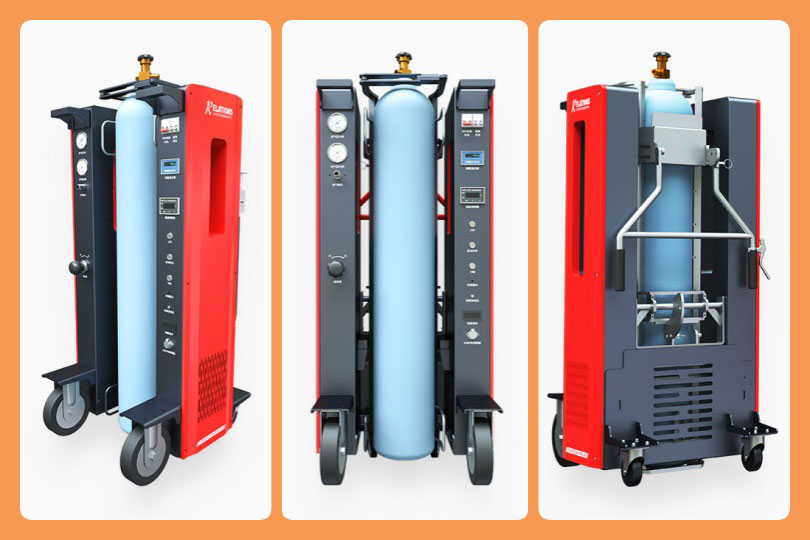
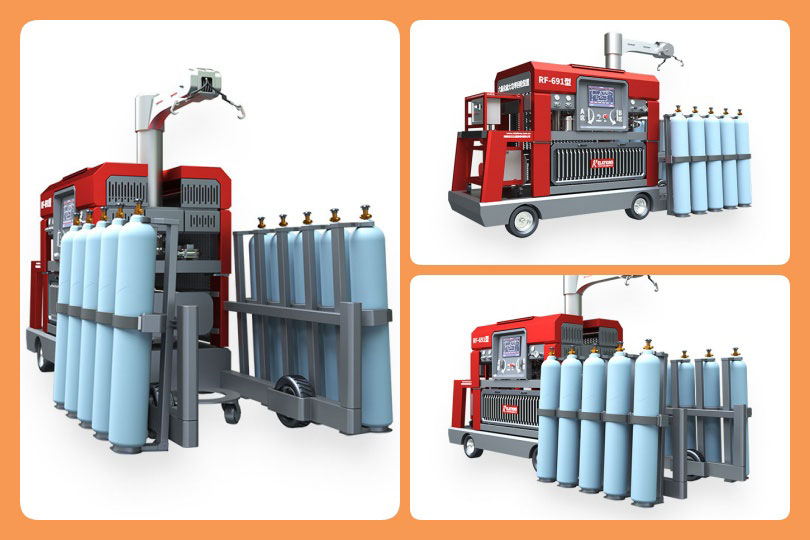
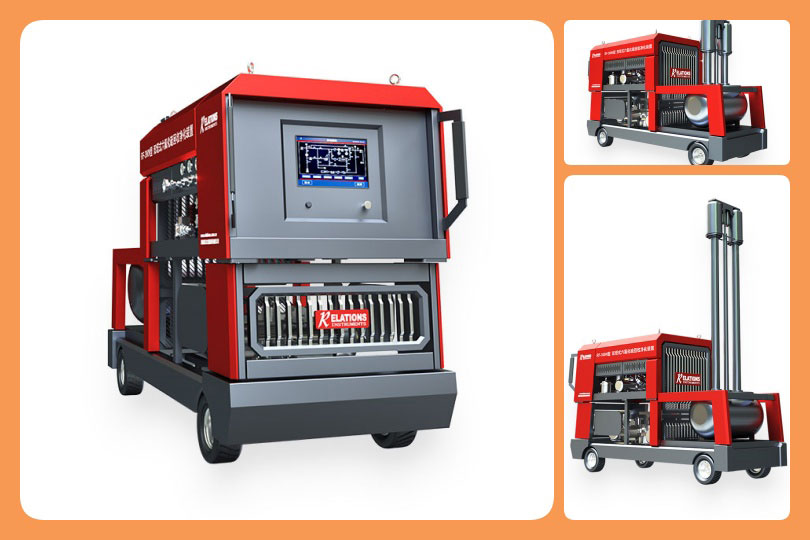
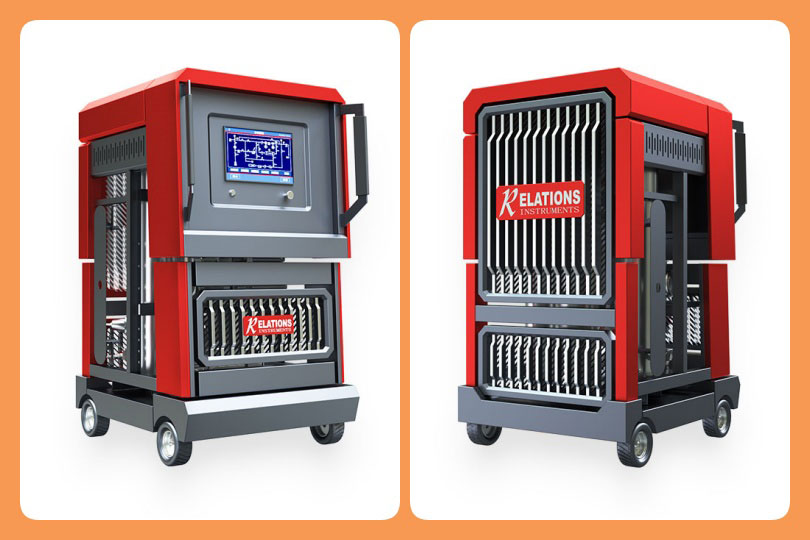
A third-party inspector acts as an unbiased bridge between the manufacturer and the end-user. Their role is to verify that the device—such as a mobile SF6 filling unit with integrated weighing and heating—meets the rigorous technical specifications promised in the data sheet and complies with international safety benchmarks like the CE Certification.
2. Structural and Mechanical Integrity Assessment
The first phase of a professional inspection involves the physical “hard” components of the device. Since these units are often used in “harsh road conditions,” the structural durability is paramount.
Mobility and Build Quality
Inspectors evaluate the chassis and wheel assembly. Professional units typically use 10-inch PU (Polyurethane) wheels to ensure maneuverability across gravel substations. The inspector checks:
-
Weld Integrity: Ensuring the frame can support a 40L gas cylinder (approx. 60kg empty plus gas weight).
-
Ergonomics: Verification of the “hand-push mobile” design to ensure it meets workplace safety standards for manual handling.
3. Verifying the Integrated Weighing System
The core of an SF6 filling device is its ability to quantify the amount of gas transferred. This is the most critical part of how to conduct third-party quality inspection for SF6 filling equipment.
Precision and Calibration
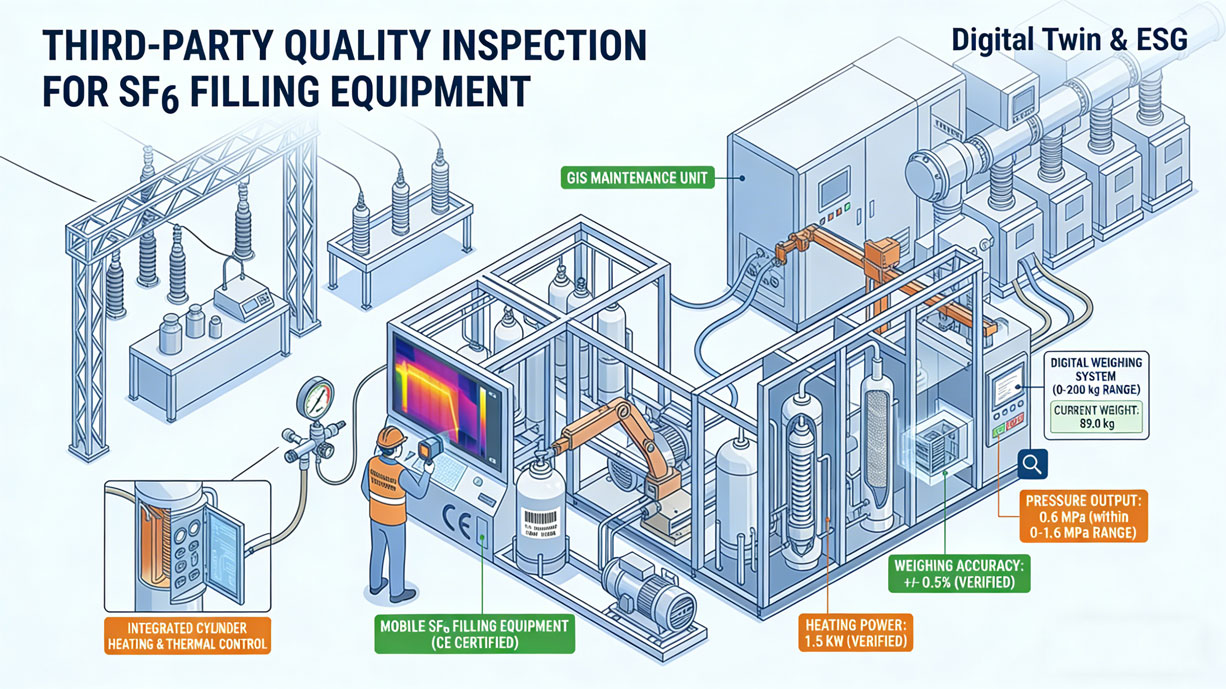
The inspector uses certified standard weights to test the 0 to 200 kg weighing range.
-
Zero Point Stability: Does the scale return to 0.00kg after a load is removed?
-
Linearity Test: The inspector adds weights in increments (e.g., 10kg, 50kg, 100kg) to ensure the digital display remains accurate across the entire spectrum.
-
Real-time Display Sync: Ensuring that as gas is depleted during a simulated filling, the display updates without lag, allowing the operator to stop exactly at the target weight.
4. Testing the Automated Heating and Thermal Control
Because SF6 undergoes significant cooling during expansion (the Joule-Thomson effect), gas cylinders can freeze, causing the pressure to drop and the filling process to stall.
Heating Efficiency and Safety
The third-party inspector evaluates the 1.5kW heating system:
-
Thermostat Accuracy: Does the heater shut off automatically once the set temperature is reached?
-
Heat Distribution: Using thermal imaging, inspectors verify that the heating jacket or cradle applies heat evenly to the 40L cylinder to prevent localized hotspots.
-
Insulation Resistance: A mandatory electrical safety test ensures that the heating element (powered by AC220V) does not leak current to the frame of the device.
5. Pressure Regulation and Valve Functional Analysis
Standard SF6 filling equipment must be able to step down the high pressure of the storage cylinder to the specific rated pressure of the GIS (usually between 0.4 MPa and 0.7 MPa).
Pressure Range Verification
The inspector tests the 0 to 1.6 MPa pressure regulation range:
-
Regulator Stability: Under flow conditions, does the regulator maintain a steady output pressure?
-
Overpressure Protection: Testing the safety relief valves to ensure they trigger if the pressure exceeds the equipment’s rated limit.
-
Leak Testing: Using an SF6 leak detector with sensitivity of at least 1 ppm, the inspector checks all joints, hoses, and the regulator body for “micro-leaks.
6. Electrical Safety and CE Compliance Audit
For any device used in industrial environments, electrical safety is non-negotiable. Third-party quality inspection must include a formal review of the CE Certification documents.
Technical Parameter Verification
-
Power Draw: Verification that the device draws no more than the rated 1.5kW to prevent overloading substation auxiliary power circuits.
-
Grounding Continuity: Ensuring the resistance between the ground pin of the plug and the metal frame is less than 0.1 ohm.
-
Emergency Stop: Verification that the heating and weighing electronics can be isolated quickly in an emergency.
7. Inspection Checklist for Technical Parameters
When conducting the inspection, the following table serves as the professional benchmark for “Pass/Fail” criteria:
| Parameter | Specification | Inspection Method |
| Pressure Range | 0 to 1.6 MPa | Manometer cross-check |
| Cylinder Compatibility | 40L Standard | Fitment test |
| Weighing Accuracy | 0 to 200 kg (+/- 0.5%) | Standard weight calibration |
| Heating Power | 1.5 kW | Current/Voltage clamp test |
| Maneuverability | 10-inch PU Wheels | Obstacle course test |
| Voltage Requirement | AC220V, 50Hz | Power analyzer check |
| Total Weight | 60 kg | External platform scale |
8. Conclusion: Ensuring Long-term Operational Reliability
Understanding how to conduct third-party quality inspection for SF6 filling equipment is the final safeguard in the procurement chain. A high-quality device—characterized by a compact structure, independent functions, and robust mobility—only proves its value when its weighing and heating accuracy are verified by an independent expert.
By adhering to this inspection framework, utilities can ensure that their SF6 handling is safe, compliant with environmental regulations, and precise enough to protect their most valuable high-voltage assets.