CE/UL Certified SF6 Leak Detection for Renewable Energy Systems: Ensuring Compliance and Reliability
Date
2026-03-05
[email protected]
Website
www.sf6gasdetector.com
Get Solutions And Quotes
CE/UL Certified SF6 Leak Detection for Renewable Energy Systems: Ensuring Compliance and Reliability
The global shift toward a carbon-neutral future has accelerated the deployment of utility-scale renewable energy assets. From offshore wind farms to massive photovoltaic (PV) arrays, the infrastructure supporting these systems relies heavily on medium and high-voltage Gas Insulated Switchgear (GIS). At the heart of this equipment is Sulfur Hexafluoride (SF6), a gas with unparalleled insulating and arc-quenching properties.
However, as the renewable energy sector matures, it faces tightening regulatory scrutiny. For asset managers and O&M (Operations and Maintenance) leads, the challenge is twofold: maintaining equipment uptime in harsh environments and meeting rigorous international safety and environmental standards. This is where CE/UL certified SF6 leak detection for renewable energy systems becomes an indispensable asset.
1. The Critical Intersection of SF6 and Renewables
While renewable energy is “green” at the point of generation, the sulfur hexafluoride used in its distribution is the most potent greenhouse gas known, with a global warming potential 23,500 times that of CO2.
The Regulatory Landscape
Governments and environmental agencies are no longer overlooking “fugitive emissions.”
-
European Union: The F-gas Regulation (EU 517/2014) mandates strict leakage checks and record-keeping for SF6 equipment.
-
North America: The EPA and various state-level bodies (like California’s ARB) require detailed reporting on gas inventories and leak rates.
Using CE/UL certified equipment is not just a badge of quality; it is a legal safeguard. CE marking indicates conformity with health, safety, and environmental protection standards for products sold within the European Economic Area, while UL certification ensures the device meets the stringent safety requirements of Underwriters Laboratories in North America.
2. Addressing Key Customer Pain Points
Maintenance teams in the renewable sector operate under unique pressures. Understanding these pain points is essential for selecting the right detection technology.
A. Harsh Environmental Conditions
Offshore wind turbines are subject to salt-mist corrosion and constant vibration. Solar farms in desert regions face extreme thermal cycling. These conditions lead to “micro-leaks” in seals and gaskets that are difficult to find with standard tools.
B. The Cost of Downtime
In a 500MW solar plant, a single switchgear failure can take a significant portion of the field offline. Traditional leak detection often requires shutting down equipment for “soapy water” tests or pressure monitoring. Customers need a solution that allows for live-line testing without interrupting power generation.
C. Accuracy and “False Positives”
Older “corona discharge” or electrochemical sensors often struggle with cross-sensitivity. Moisture, cleaning agents, or ozone can trigger false alarms, leading to unnecessary maintenance “wild goose chases.”
3. The Superiority of NDIR Technology in Certified Detectors
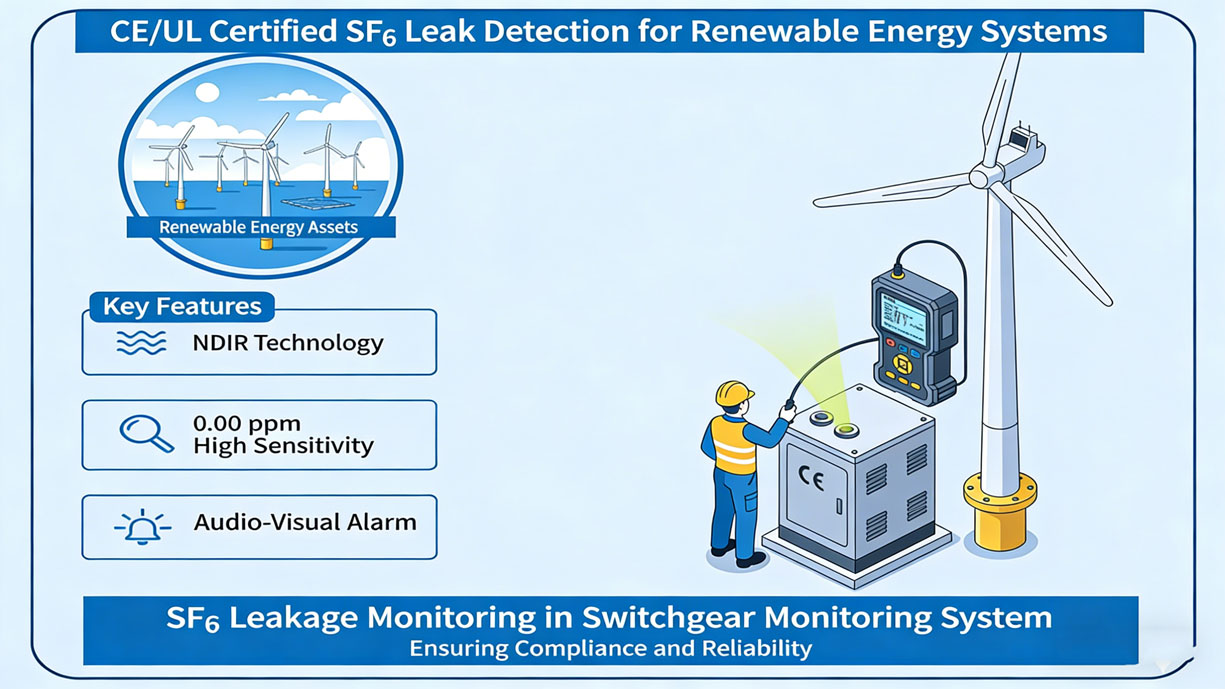
To address these pain points, the industry has moved toward Non-Dispersive Infrared (NDIR) technology. Unlike other methods, NDIR is a physical measurement rather than a chemical one.
How NDIR Works
The sensor emits an infrared beam at a specific wavelength that only SF6 molecules absorb. By measuring the light attenuation, the device can provide a quantitative result—literally counting the number of SF6 molecules in the air.
-
Selectivity: NDIR sensors are “blind” to other gases, eliminating false positives.
-
Sensitivity: High-end certified units can detect leaks as small as 0.01 ppm (parts per million), allowing technicians to find “seeping” leaks before they become catastrophic failures.
4. Why CE and UL Certification Matters
For a procurement officer or a safety manager, certifications provide a layer of “risk transfer.”
CE Certification: The European Standard
CE certified SF6 leak detectors ensure the device complies with Electromagnetic Compatibility (EMC) directives. In the high-interference environment of a substation, you cannot have a leak detector that either causes interference with digital relays or is susceptible to the massive electromagnetic fields generated by high-voltage cables.
UL Certification: Safety and Fire Protection
UL certification focuses heavily on the electrical safety of the tool itself. Given that these detectors are used around high-voltage equipment, ensuring the device won’t spark, overheat, or fail in a way that endangers the operator is paramount.
5. Strategic Benefits for Renewable Energy O&M
Implementing CE/UL certified SF6 leak detection for renewable energy systems offers three primary strategic advantages:
1. Predictive Maintenance vs. Reactive Repair
With a high-sensitivity (0.01 ppm) detector, you can trend a leak over time. If a seal is degrading at a rate of 2 grams per year, you can schedule the repair during a planned outage rather than waiting for the density relay to trip and the system to go dark.
2. Environmental ESG Reporting
Most major renewable energy developers are publicly traded and must report their ESG (Environmental, Social, and Governance) metrics. Using a SF6 quantitative leak detector allows you to record the exact leakage rate, providing the “hard data” required for annual sustainability reports.
3. Personnel Safety
SF6 is heavier than air. In the basement of a substation or the nacelle of a wind turbine, a major leak can lead to oxygen displacement and asphyxiation. A certified detector with an audio-visual alarm provides the immediate warning necessary to protect lives.
6. Technical Specifications for the Ideal Renewable Energy Tool
When evaluating a CE/UL certified detector, look for the following specifications:
| Feature | Requirement | Benefit |
| Technology | NDIR (Infrared) | Zero false positives; 10-year sensor life |
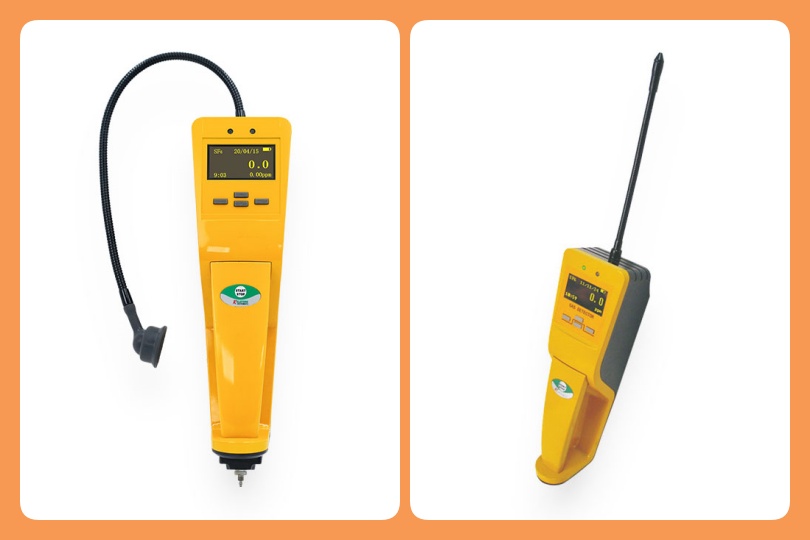
| Sensitivity | 0.01 ppm to 0.1 ppm | Finds micro-leaks early |
| Certifications | CE, UL, RoHS | Global compliance and safety |
| Response Time | Less than 1 second | Faster inspection of multiple joints |
| Display | OLED / High-Contrast | Visibility in direct sunlight (Solar farms) |
| Sampling Method | Internal Pump-Suction | Reaches recessed joints in GIS |
7. Best Practices: How to Conduct a Certified Leak Audit
To get the most out of your certified equipment, follow this rigorous inspection protocol:
-
Zeroing in Clean Air: Always calibrate the “zero point” in an area known to be free of SF6.
-
Bottom-Up Scanning: Since SF6 is heavy, start scanning from the bottom of the flange or valve and work upward.
-
Airflow Management: Turn off ventilation systems during the test if possible. Even a light breeze in a substation can disperse a micro-leak before the probe can capture it.
-
Documentation: Use the tool’s internal memory to record the location and ppm level of every leak found. This forms the basis of your SF6 inventory management.
8. Conclusion: Future-Proofing the Green Grid
As the world adds more gigawatts of renewable energy, the “invisible” threat of SF6 leakage grows. We are entering an era where “guessing” at gas levels is no longer acceptable to regulators or investors.
Investing in CE/UL certified SF6 leak detection for renewable energy systems is a commitment to quality. It protects your personnel from the hazards of gas accumulation, protects your assets from unplanned downtime, and protects the environment from potent greenhouse emissions. By choosing NDIR-based, certified technology, you ensure that your renewable energy infrastructure remains as green as the power it produces.