Portable Infrared SF6 Gas Quantitative Leak Detector for the Electronics and Semiconductor Industry
Date
2026-03-05
[email protected]
Website
www.sf6gasdetector.com
Get Solutions And Quotes
Portable Infrared SF6 Gas Quantitative Leak Detector for the Electronics and Semiconductor Industry
The semiconductor and electronics manufacturing industries operate at the absolute frontier of precision and purity. As global demand for high-performance microchips, liquid crystal displays (LCDs), and advanced electronic components surges, the industrial processes supporting their creation have become increasingly complex. One of the most critical materials in these processes is Sulfur Hexafluoride (SF6). While primarily known for its role in high-voltage power distribution, SF6 is an indispensable “etching gas” and cleaning agent in the semiconductor industry.
However, the use of SF6 carries significant operational and environmental risks. To manage these risks, the deployment of a Portable Infrared SF6 Gas Quantitative Leak Detector for the Electronics and Semiconductor Industry has become a mandatory standard for facilities aiming for excellence in safety and sustainability.
1. The Strategic Role of SF6 in Semiconductor Fabrication
In the electronics industry, SF6 is utilized for plasma etching, particularly in the production of high-density circuits. Its ability to create deep, vertical trenches in silicon—a process known as Deep Reactive Ion Etching (DRIE)—is vital for creating the architecture of modern microprocessors.
Despite its utility, SF6 is the most potent greenhouse gas known to man, with a Global Warming Potential (GWP) 23,500 times that of CO2. Furthermore, in a cleanroom environment, even a microscopic leak from gas delivery lines, mass flow controllers, or vacuum chambers can contaminate the production environment, leading to yield loss and potential health risks for technicians.
2. NDIR Technology: The Gold Standard for SF6 Detection
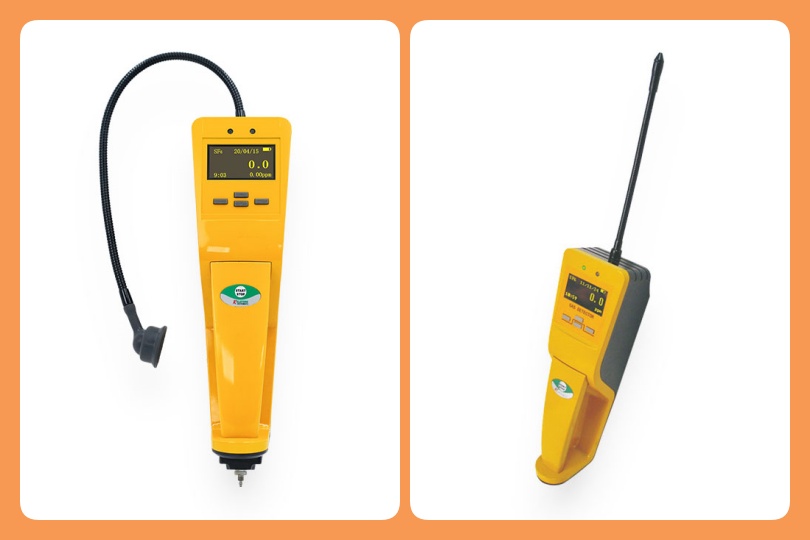
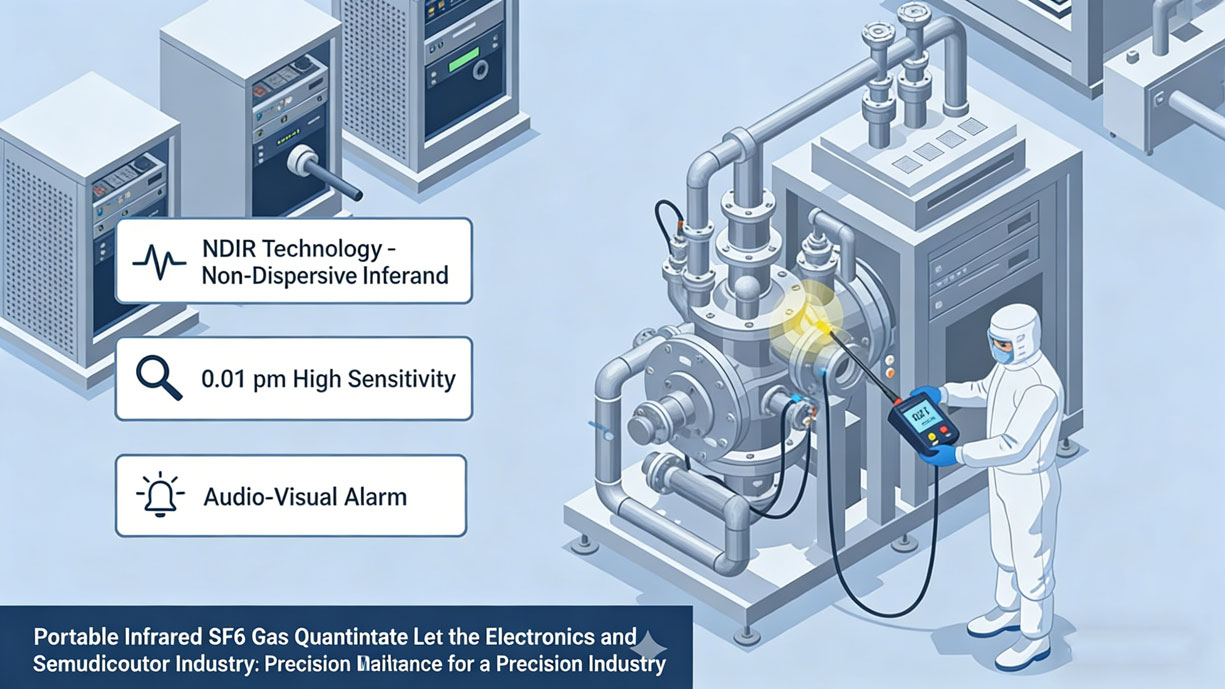
The Portable Infrared SF6 Gas Quantitative Leak Detector for the Electronics and Semiconductor Industry utilizes Non-Dispersive Infrared (NDIR) technology. In a sector where “ppm” (parts per million) can be the difference between a successful batch and a million-dollar failure, NDIR stands out as the only reliable method for quantitative analysis.
The Physics of NDIR Sensing
Every gas molecule has a unique “infrared signature.” SF6 strongly absorbs infrared light at specific wavelengths. The NDIR sensor emits a beam of infrared light through a sample chamber; the more SF6 present, the more IR light is absorbed.
Unlike traditional “corona discharge” or electrochemical sensors, our NDIR technology offers:
-
Zero Interference: It does not react to humidity, cleaning solvents (like IPA), or other process gases common in semiconductor fabs.
-
Rapid Response: With a response time of 1 to 5 seconds, technicians can sweep large gas manifolds quickly.
-
Quantitative Accuracy: It provides a literal measurement in ppm or g/y (grams per year), rather than a vague “high/low” alarm.
3. High-Sensitivity for Micro-Leak Detection
Semiconductor facilities require a level of sensitivity that far exceeds standard industrial requirements. Our SF6 gas leak detector is available in a High-Sensitivity Model specifically tuned for the electronics sector:
-
Sensitivity of 0.01 ppm: This allows for the detection of “background” leaks that might not trigger standard safety alarms but indicate a failing seal or a hairline fracture in a stainless steel line.
-
Precision of 0.1 ppm: High-resolution data allows for “Leak Rate Quantification,” enabling maintenance teams to prioritize repairs based on the actual mass of gas escaping.
4. Designed for the Cleanroom: Ergonomics and Utility
A tool is only as good as its usability in the field. Our portable SF6 gas quantitative leak detector is engineered for the unique constraints of cleanroom and sub-fab environments.
OLED Display and Visibility
Traditional LCD screens can be difficult to read under the high-intensity LED lighting of a fab. Our unit features an OLED display. Being self-luminous, it offers high brightness and a wide viewing angle, ensuring the data is visible even when the technician is reaching into a dark corner of a Gas Box or Tool Pedestal.
Pump-Suction Sampling
The SF6 gas quantitative leak detector utilizes a powerful internal pump and a 22cm probe. This “sniffer” design is essential for checking recessed joints, flange edges, and valve seats that are physically inaccessible to the detector’s body.
Data Management and Traceability
In an industry governed by ISO standards and environmental reporting, data traceability is key.
-
Storage Modes: The device supports both automatic and manual data logging.
-
Digital Integration: Measurements can be stored and later analyzed to identify recurring “weak points” in the gas delivery infrastructure.
5. Technical Specifications: A Professional Benchmark
| Parameter Name | High-Sensitivity Specification | Electronics Industry Benefit |
| Measurement Principle | Non-Dispersive Infrared (NDIR) | Unmatched stability and gas specificity |
| Measurement Range | 0 – 50 ppm | Focused on micro-leak detection |
| Sensitivity | 0.01 ppm | Finds leaks before they impact yield |
| Response Time | 1 – 5 seconds | High-speed manifold scanning |
| Operating Temp | -20 to 60 degrees Celsius | Works in both sub-fabs and chilled cleanrooms |
| Power Supply | 2200mAh Lithium Battery | Full-day operation on a single USB charge |
| Service Life | More than 10 Years | Robust ROI for facility management |
6. Proactive Maintenance: Reducing Yield Loss and Environmental Impact
Implementing a Portable Infrared SF6 Gas Quantitative Leak Detector for the Electronics and Semiconductor Industry is a strategic move that pays dividends in three specific areas:
1. Yield Protection
Even trace amounts of SF6 leaking into the ambient cleanroom air can disrupt sensitive chemical balances. Furthermore, a leak in the DRIE gas line means the etching process may not receive the correct flow, leading to inconsistent trench depths on the wafer.
2. Environmental Compliance and ESG
Global semiconductor giants are under immense pressure to reduce their carbon footprint. Since SF6 is a major contributor to “Scope 1” emissions, identifying and fixing leaks at the 0.01 ppm level is the most effective way to meet corporate sustainability goals and avoid carbon taxes.
3. Personnel Safety
While SF6 is non-toxic, it can displace oxygen in sub-fab areas. More importantly, under certain conditions, SF6 can break down into toxic byproducts. A high-sensitivity detector provides the first line of defense, alerting staff to a breach in containment before it becomes a hazardous event.
7. Calibration and Long-Term Reliability
The semiconductor industry relies on equipment that stays in calibration. Our NDIR sensor is designed for stability, requiring calibration only once every 6 months. With an expected service life of over 10 years, the detector is a durable asset that survives the rigorous pace of a 24/7 manufacturing facility.
8. Conclusion: Precision Maintenance for a Precision Industry
The Portable Infrared SF6 Gas Quantitative Leak Detector for the Electronics and Semiconductor Industry is more than just a safety tool—it is a piece of precision metrology. By combining the molecular specificity of NDIR technology with the sensitivity required for cleanroom environments, it allows fab managers to protect their yields, their people, and the planet.
As we move toward even smaller nanometer nodes and more complex 3D chip architectures, the tolerance for gas leakage will continue to shrink. Investing in 0.01 ppm sensitivity today is the only way to ensure your facility is ready for the manufacturing challenges of tomorrow.