Precision Gas Monitoring: ppm g/y SF6 Measurement for GIS Leak Detection Thailand
Date
2026-02-24
[email protected]
Website
www.sf6gasdetector.com
Get Solutions And Quotes
Precision Gas Monitoring: ppm g/y SF6 Measurement for GIS Leak Detection Thailand
The energy landscape in Southeast Asia is rapidly evolving, with Thailand leading the charge in smart grid integration and sustainable utility management. As the Electricity Generating Authority of Thailand (EGAT) and various Provincial Electricity Authorities (PEA) expand their High Voltage (HV) infrastructure, the maintenance of Gas Insulated Switchgear (GIS) has become a top priority. Central to this maintenance is the ability to perform precise ppm g/y SF6 measurement for GIS leak detection Thailand, ensuring both operational continuity and environmental responsibility.
Sulfur Hexafluoride (SF6) remains the industry standard for insulation and arc quenching. However, its significant global warming potential necessitates advanced detection technologies. The shift from basic “leak/no-leak” indicators to quantitative infrared (NDIR) detection is a game-changer for Thai industrial and utility sectors.
1. The Critical Need for Quantitative Analysis in Thailand
Thailand’s tropical climate presents unique challenges for GIS installations. High humidity and ambient temperatures ranging from 25°C to over 40°C can accelerate the aging of gaskets and seals. In such environments, a minor leak can quickly escalate into a dielectric failure if not quantified early.
The adoption of ppm g/y SF6 measurement for GIS leak detection Thailand provides two critical data points:
-
ppm (parts per million): Measures the current concentration of SF6 in the immediate vicinity, essential for technician safety and locating the source.
-
g/y (grams per year): Provides the annual leak rate, allowing maintenance managers to calculate gas loss costs and prioritize repairs based on the severity of the leak.
This quantitative approach aligns with Thailand’s commitment to international environmental standards and the reduction of greenhouse gas emissions in the power sector.
2. NDIR Technology: The Standard for Modern Leak Detection
Traditional detection methods often fail in the complex electromagnetic environments of a substation. Our SF6 infrared leak detector utilizes Non-Dispersive Infrared (NDIR) absorption spectroscopy, a principle that offers unparalleled accuracy for ppm g/y SF6 measurement for GIS leak detection Thailand.
How it Works
The NDIR sensor identifies SF6 by its unique infrared absorption footprint. Because the sensor does not rely on a chemical reaction, it is not “poisoned” by high concentrations of gas and is immune to cross-interference from moisture or other gases common in industrial areas.
Key Performance Benefits:
-
High Sensitivity: With detection limits as low as 0.01 ppm in high-sensitivity models, even the most minute micro-leaks can be identified before they become measurable on a pressure gauge.
-
Automatic Zero Correction: The system automatically adjusts for zero-point drift, ensuring that measurements taken in the field remain as accurate as those in the laboratory.
-
Rapid Response: A response time of 1 to 5 seconds allows technicians to scan large GIS bays efficiently, significantly reducing man-hours during maintenance shutdowns.
3. Product Features Tailored for the Thai Utility Sector
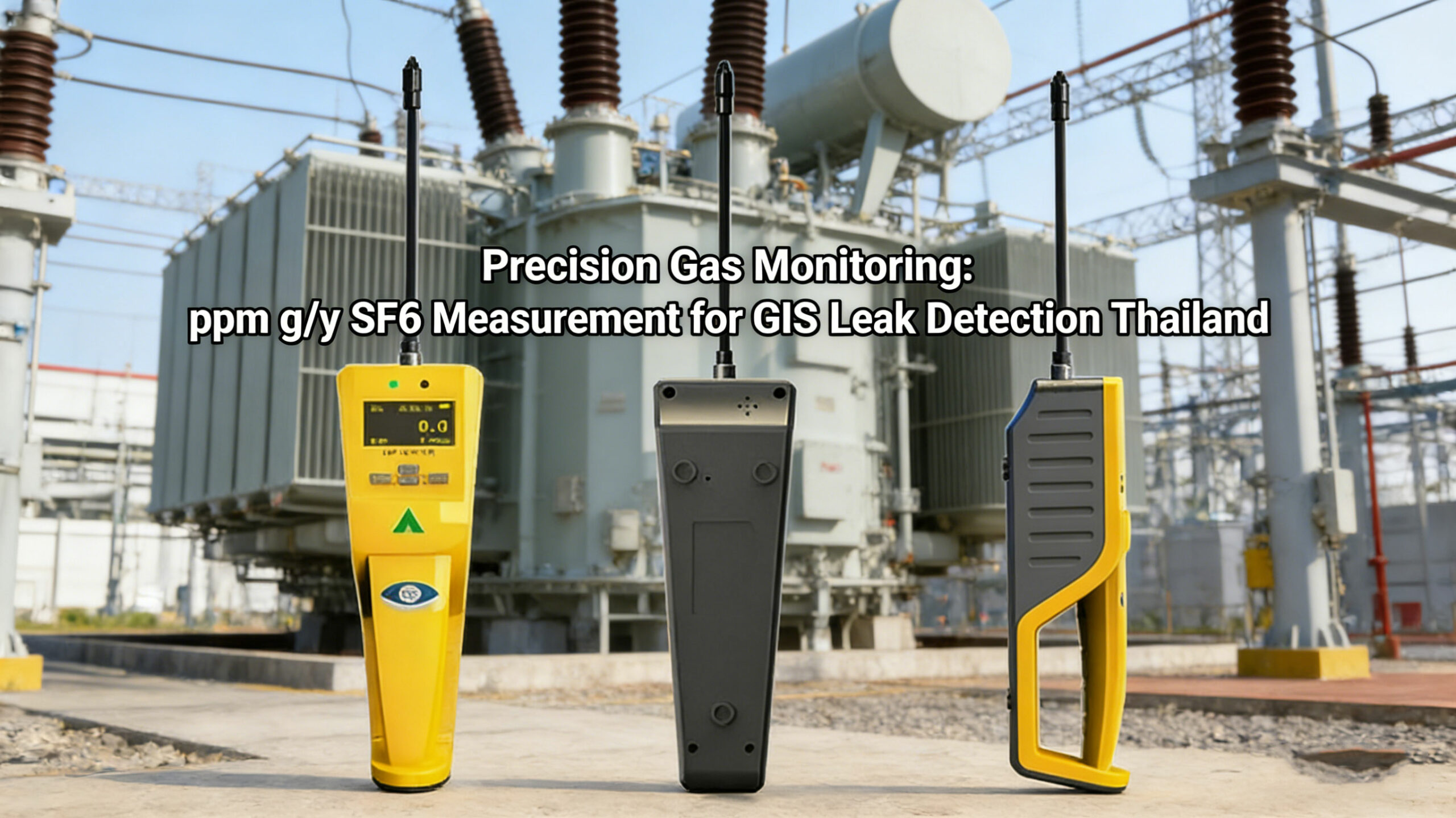
Maintenance tools in Thailand must be robust, easy to read in bright sunlight, and highly portable. The infrared SF6 detector is engineered with these field requirements in mind.
OLED High-Visibility Display
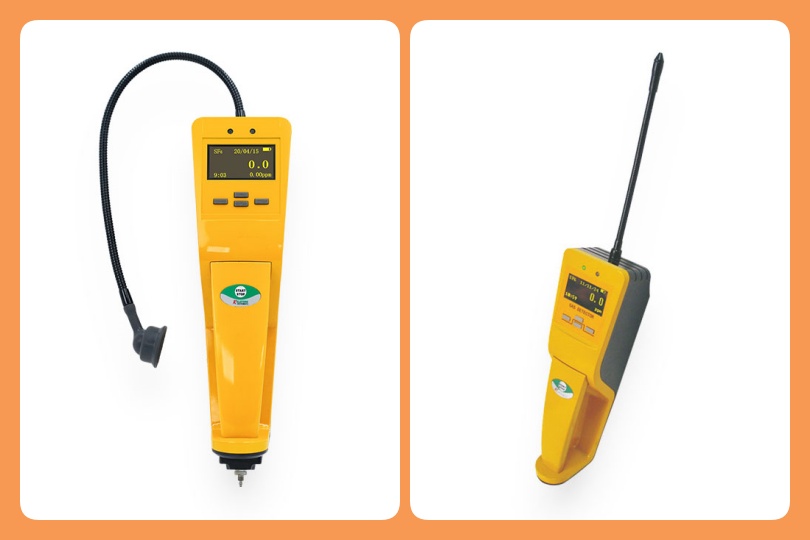
Standard LCD screens often wash out under the intense Thai sun. This detector features an OLED display, which is self-luminous and provides high contrast even in direct sunlight. With a wide viewing angle and low power consumption, it ensures that critical ppm g/y SF6 measurement for GIS leak detection Thailand is visible to the operator at all times.
Ergonomic Handheld Design
The device is designed for one-handed operation. Its lightweight frame and 22cm probe rod allow technicians to reach deep into GIS enclosures, ring main units (RMUs), and behind cable terminations. The “pump-suction” sampling method ensures that the gas is actively drawn into the sensor, providing immediate feedback as the probe passes a leak point.
Data Management and Storage
In the era of “Industry 4.0,” manual logbooks are being replaced by digital records. This detector supports both automatic and manual data storage, allowing maintenance teams to export leak data for historical analysis and compliance reporting.
4. Technical Specifications
For professional engineering teams, the reliability of a tool is found in its specifications. The following parameters define the industry-leading performance of our NDIR detector:
| Parameter | Specification |
| Measurement Principle | Non-Dispersive Infrared (NDIR) |
| Measuring Units | ppm and g/y (Toggleable) |
| Sensitivity (High Mode) | 0.01 ppm |
| Accuracy (High Mode) | 0.1 ppm |
| Sampling Method | Built-in Pump Suction |
| Operating Temperature | -20°C to 60°C (Ideal for Thai climate) |
| Response Time | 1 ~ 5 seconds |
| Battery | 4.2V DC, 2200mAh Lithium (USB Chargeable) |
| Sensor Lifespan | > 10 Years |
5. Implementation in GIS Maintenance Protocols
Effective GIS maintenance in Thailand involves a tiered approach where ppm g/y SF6 measurement for GIS leak detection Thailand plays a central role.
Step 1: Preliminary Screening
Using the standard range (0-1000 ppm), technicians perform a rapid sweep of all flanges, valves, and pressure gauge connections. The audible and visual alarms provide instant notification of gas presence.
Step 2: Precision Pinpointing
Upon detection, the device is switched to high-sensitivity mode. By utilizing the g/y measurement, the technician can determine if the leak is a “nuisance” leak (below 0.5 g/y) or a “critical” leak requiring immediate intervention.
Step 3: Verification Post-Repair
After replacing seals or tightening joints, the detector provides the final validation. A “zero ppm” reading confirms that the equipment is hermetically sealed, protecting the asset for the next maintenance cycle.
6. Strategic and Economic Advantages
For utility providers like EGAT, PEA, and MEA, as well as private power producers in Thailand, the investment in high-precision detection technology yields immediate returns.
-
Asset Protection: GIS equipment is a massive capital investment. Preventing low-pressure lockouts and internal arcing through early leak detection extends the life of the switchgear by decades.
-
Environmental Leadership: As Thailand moves toward more stringent carbon reporting, being able to quantify SF6 loss in g/y is essential for corporate social responsibility (CSR) and international compliance.
-
Reduced Gas Costs: SF6 gas is expensive. Reducing the annual leak rate across a fleet of substations saves significant procurement costs over time.
Conclusion: Elevating Thailand’s Grid Reliability
The ppm g/y SF6 measurement for GIS leak detection Thailand is an indispensable component of modern electrical maintenance. By choosing a detector that combines NDIR precision with rugged, handheld portability, Thai utility operators can ensure their substations remain safe, efficient, and environmentally sound.
In the demanding conditions of Thailand’s energy sector, only the highest level of quantitative accuracy will suffice to protect the nation’s power future.