SF6 Density Transmitter Manufacturer: Monitor GIS Gas Compartments Digitally
Date
2026-11-16
[email protected]
Website
www.sf6gasdetector.com
Get Solutions And Quotes
Contact Factory
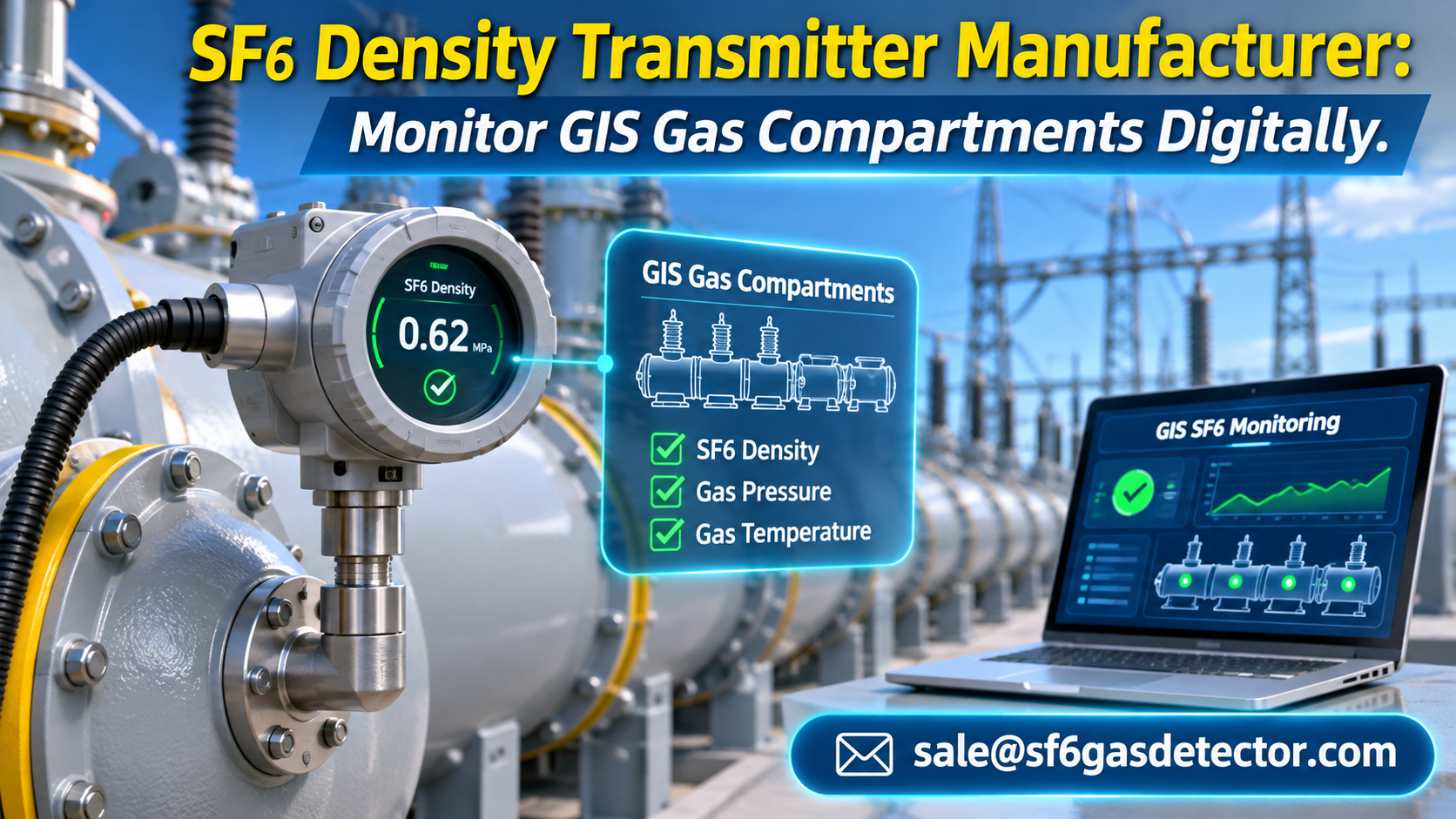
SF6 Density Transmitter Manufacturer: Monitor GIS Gas Compartments Digitally
Selecting a digital SF6 density transmitter manufacturer for GIS gas compartments requires more than comparing sensor accuracy or communication protocols. In gas-insulated switchgear, reliable density monitoring supports insulation integrity, alarm management, and maintenance planning. The right transmitter must match the compartment’s gas composition, filling conditions, operating environment, and control architecture. Equally important, its performance must be supported by traceable calibration, relevant test evidence, and clearly documented limitations.
Why Digital Density Monitoring Matters in GIS
SF6 provides insulation and arc-quenching performance in electrical equipment designed for its use. In GIS gas compartments, declining gas density can reduce the dielectric margin established by the equipment manufacturer.
Pressure alone is not a reliable indicator of gas loss because it changes with temperature. A digital density transmitter generally measures pressure and temperature, then applies a gas-specific relationship to calculate density or equivalent pressure at a reference temperature.
An experienced SF6 density transmitter manufacturer should identify the calculation method, reference conditions, and supported gas compositions. A device calibrated for pure SF6 must not be assumed suitable for alternative gases or mixtures.
Density Is Not a Complete Gas-Condition Assessment
Density monitoring does not independently determine moisture content, decomposition products, or gas purity. These require appropriate analytical instruments and maintenance procedures. Digital monitoring complements, rather than replaces, the GIS manufacturer’s inspection and gas-quality requirements.
Define the Technical Specification Before Requesting Quotations
A qualified SF6 density transmitter manufacturer should evaluate application data before recommending a model. For GIS gas compartments, procurement specifications should distinguish normal operating conditions from abnormal events and proof-test limits.
| Parameter | What the specification should establish |
|---|---|
| Gas composition | Pure SF6 or an explicitly identified mixture |
| Measurement range | Coverage of filling, alarm, and permitted operating conditions |
| Reported variable | Density, absolute pressure, or equivalent pressure at a stated reference temperature |
| Accuracy | Total compensated error across the specified temperature range |
| Temperature limits | Separate ambient, gas, operating, and storage limits |
| Mechanical interface | Thread or flange, seal material, valve arrangement, and installation orientation |
| Electrical interface | Supply voltage, power consumption, isolation, and surge protection |
| Communication | Protocol, register map, update rate, diagnostics, and failure indication |
| Environmental protection | Required ingress protection, corrosion resistance, vibration, and EMC performance |
| Calibration | Traceability, test points, uncertainty, and acceptance criteria |
A stated pressure accuracy at room temperature is not equivalent to density accuracy across the operating envelope. Ask the SF6 density transmitter manufacturer whether published performance includes temperature measurement error, compensation uncertainty, hysteresis, and long-term drift.
For GIS gas compartments exposed to rapid thermal changes, sensor placement also matters. Temperature differences between the gas, enclosure, and transmitter can temporarily affect calculated density.
Verify Standards, Certifications, and Supporting Evidence
No single certificate establishes universal suitability for every GIS installation. A credible SF6 density transmitter manufacturer should provide a compliance matrix linking each requirement to the supplied product configuration.
Relevant Standards and Their Limits
IEC 62271-203 addresses AC gas-insulated metal-enclosed switchgear rated above 52 kV, while IEC 62271-1 establishes common specifications for high-voltage switchgear and controlgear. These standards inform equipment-level requirements; they do not automatically certify an individual transmitter.
Other relevant references include:
- IEC 60529: enclosure ingress-protection classifications.
- IEC 61326-1: EMC requirements for electrical measurement and control equipment, where applicable.
- IEC 60068 series: environmental testing using application-appropriate methods and severities.
- IEC 60376: specifications for technical-grade SF6 and complementary gases.
- IEC 60480: specifications for reuse of SF6 and its mixtures in electrical equipment.
ISO 9001 certification supports confidence in a manufacturer’s quality-management system but does not establish measurement accuracy. Calibration from an ISO/IEC 17025-accredited laboratory provides stronger evidence when the relevant measurement falls within its accredited scope.
For EU projects, assess applicable legislation, including Regulation (EU) 2024/573 on fluorinated greenhouse gases. Its requirements include phased switchgear restrictions and exceptions; installing a transmitter does not make an otherwise restricted SF6 application permissible.
Match the Transmitter to the Operating Scenario
New GIS Installations
For new GIS gas compartments, coordinate transmitter selection with the switchgear OEM. Confirm connection geometry, gas-tightness requirements, wiring, alarm thresholds, and commissioning procedures before production.
The SF6 density transmitter manufacturer should supply interface drawings and protocol documentation early enough for factory integration testing. Where independent alarm or lockout contacts are required, verify that the complete monitoring arrangement provides them; digital telemetry alone may not satisfy the protection philosophy.
Retrofit Projects
Retrofitting GIS gas compartments requires special attention to isolation valves, adapter dead volume, and existing alarm functions. Do not assume a sensor can be removed without gas recovery.
Choose an SF6 density transmitter manufacturer that can document compatibility with the installed connection. Changes should preserve OEM-approved operating limits and undergo the asset owner’s engineering approval process.
Remote and Unattended Substations
Remote installations benefit from timestamped trends, sensor diagnostics, communication-loss alarms, and local data buffering. Slow density decline may indicate leakage, but interpretation should account for thermal transients and measurement uncertainty.
Ask the SF6 density transmitter manufacturer how the device reports invalid readings, power interruptions, and internal faults. Network access controls and secure gateways should follow the utility’s cybersecurity architecture.
Commissioning and Lifecycle Support
Before energization, verify device identity, calibration records, reference-temperature settings, communication scaling, and alarm mapping. Check gas connections for leakage using approved procedures.
Maintenance intervals should follow OEM guidance, operating experience, and local requirements—not a universal annual replacement rule. Gas handling must use trained personnel and suitable recovery equipment; routine venting is inappropriate.
Frequently Asked Questions
Can one transmitter monitor several GIS gas compartments?
Only when those compartments form a continuously connected gas volume and the OEM approves the arrangement. Separately sealed compartments generally need individual monitoring.
Is a digital transmitter better than a mechanical density monitor?
It offers trending and diagnostics, but it is not automatically a replacement for independent switching contacts. Selection depends on the required protection and monitoring functions.
What should a supplier provide with each device?
Request serial-number traceability, calibration results, configuration records, installation instructions, and applicable conformity documentation.
A Defensible Purchasing Decision
The strongest supplier choice combines verified measurement performance, compatible interfaces, documented compliance, and dependable lifecycle support. Evaluating these factors together helps utilities obtain actionable density data without compromising switchgear safety or environmental responsibilities.