SF6 Gas Detector Supplier: Reliable High-Voltage Circuit Breaker Leak Testing

Date
2026-11-19
[email protected]
Website
www.sf6gasdetector.com
Get Solutions And Quotes
Contact Factory
SF6 Gas Detector Supplier: Reliable High-Voltage Circuit Breaker Leak Testing
Selecting an SF6 gas detector supplier for high-voltage circuit breaker leak testing requires more than comparing instrument prices or advertised sensitivity. Utilities, switchgear manufacturers, and maintenance contractors need equipment that can locate small leaks reliably, withstand site conditions, and support documented maintenance procedures. The right supplier connects detector performance with the breaker design, testing environment, applicable safety requirements, and long-term service needs—without confusing leak detection with gas-quality analysis or pressure monitoring.
Why Circuit Breaker Leak Testing Needs Specialized Equipment
SF6 provides insulation and arc-quenching performance in many installed high-voltage circuit breakers. Leakage can reduce gas density, trigger alarms, and eventually compromise the equipment’s operating margin. Because SF6 is also a potent greenhouse gas, identifying and repairing leaks supports both asset reliability and emissions management.
Typical inspection points include flange joints, valve assemblies, filling connections, pressure-monitor interfaces, and seals. However, equipment construction varies, so inspection routes should follow manufacturer drawings and maintenance instructions.
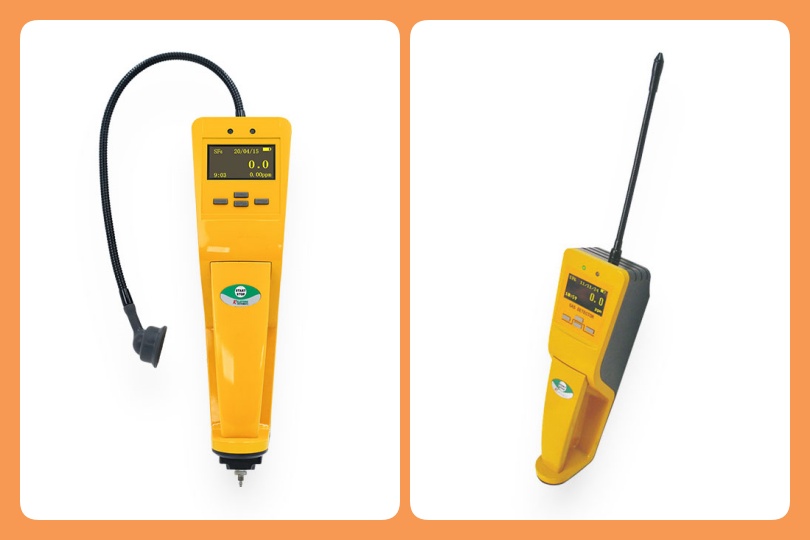
A portable SF6 leak detector locates escaping gas. It does not independently establish gas purity, moisture content, decomposition-product concentration, or the breaker’s overall fitness for service. Those assessments require appropriate instruments and separate acceptance criteria.
Technical Parameters That Matter When Comparing Suppliers
A credible supplier should provide a detailed specification supported by test conditions, calibration information, and application limitations.
| Parameter | What to request | Practical significance |
|---|---|---|
| Detection principle | Infrared, photoacoustic, or other sensing technology, with selectivity data | Helps assess suitability around interfering gases |
| Detection capability | Minimum detectable concentration and, where claimed, leak rate under stated conditions | Prevents misleading comparisons |
| Response and recovery | Defined response time, sampling flow, and recovery after high exposure | Determines inspection speed and repeatability |
| Environmental limits | Temperature, humidity, ingress protection, and storage requirements | Confirms suitability for outdoor substations |
| Probe configuration | Hose length, flexible tip, filters, and extension options | Supports access to recessed connections |
| Calibration support | Procedure, interval guidance, reference traceability, and service availability | Supports defensible maintenance records |
| Data management | Timestamped readings, equipment identifiers, and export functions | Enables repair tracking and audit documentation |
Distinguish Concentration From Leak Rate
Parts per million describes concentration; grams per year describes mass leakage. These values are not directly interchangeable without a defined measurement arrangement, gas flow, and calculation method.
An advertised minimum leak rate should therefore include the reference leak, probe distance, scan speed, and environmental conditions. For whole-breaker leakage assessment, an approved accumulation or other quantitative method may be necessary. A handheld sniffer reading alone does not establish an annual leakage rate.
Evaluate Field Performance, Not Just Laboratory Sensitivity
Wind can disperse gas before it reaches the sampling probe. Contamination, moisture, background SF6, and excessive probe speed can also affect results.
Ask for a demonstration on representative joints under realistic conditions. Confirm how the detector indicates sensor saturation, blocked flow, low battery, and calibration faults. Reliable fault indication can be as important as a low detection threshold.
Standards, Certification, and Regulatory Due Diligence
IEC 62271-1 provides common specifications for high-voltage switchgear and controlgear, while IEC 62271-100 addresses alternating-current circuit breakers. These standards inform equipment requirements; they are not blanket certifications for every handheld detector used during maintenance.
For detector safety and electromagnetic compatibility, request evidence against applicable standards such as IEC 61010-1 and IEC 61326-1, where relevant to the instrument’s design and intended use. Check the declared scope, editions, test reports, and jurisdiction-specific requirements.
Verify What Each Document Actually Proves
ISO 9001 certification concerns a supplier’s quality management system, not the accuracy of an individual detector. Likewise, CE marking is not independent proof of measurement performance. Review the EU declaration of conformity and the legislation it identifies.
Where calibration is provided by an ISO/IEC 17025-accredited laboratory, confirm that the relevant measurement falls within its accredited scope. Accreditation should not be assumed from a logo alone.
In the European Union, Regulation (EU) 2024/573 establishes fluorinated greenhouse gas obligations, including provisions affecting electrical switchgear. Requirements depend on equipment characteristics, activities, and implementation dates. Other jurisdictions impose different reporting and handling obligations.
IEC 60376 addresses technical-grade SF6 and complementary gases, while IEC 60480 addresses specifications for reuse. Neither replaces detector performance verification.
Match the Solution to the Maintenance Scenario
Outdoor Substation Troubleshooting
For investigating a gas-density alarm, prioritize portability, rapid recovery, accessible probe geometry, and stable sampling. Review density trends and temperature compensation before assuming that a pressure change confirms leakage.
Testing must remain within approved electrical clearances. Never bring a probe near energized components unless the site procedure, equipment design, and risk assessment explicitly permit it.
Factory Assembly and Acceptance Testing
Manufacturers need repeatable fixtures, controlled background conditions, and documented acceptance limits. Suppliers should support reference-leak checks and integration with the approved production test method.
Portable pinpointing can help locate defects, but it should not replace a specified quantitative acceptance test.
Indoor Switchgear Rooms
Fixed SF6 monitoring can provide area alarms, while portable instruments locate individual leaks. The two systems serve different purposes.
SF6 can displace oxygen, and gas exposed to electrical arcing may contain hazardous decomposition products. Apply ventilation, confined-space controls where relevant, and suitable protective measures. Do not rely on an SF6 leak detector as an oxygen monitor.
Frequently Asked Questions
How often should a detector be calibrated?
Follow the manufacturer’s interval and the organization’s quality procedure. Adjust intervals using utilization, exposure history, and verification results. Functional checks complement calibration but do not replace it.
Can a supplier guarantee detection of every leak?
No. Accessibility, airflow, background concentration, and measurement technique influence detection. A responsible supplier defines performance conditions and limitations rather than promising universal results.
What should a procurement package include?
Specify the instrument, accessories, calibration documentation, training, warranty, consumable availability, service turnaround, and acceptance demonstration. Include data-export requirements when maintenance records must integrate with an asset-management system.
A Defensible Procurement Decision
The best SF6 gas detector supplier for high-voltage circuit breaker leak testing provides verifiable performance, relevant compliance documentation, practical application support, and dependable lifecycle service. Evaluate suppliers against an agreed test procedure and realistic operating conditions. This approach produces more credible leak assessments, better maintenance decisions, and stronger emissions accountability.