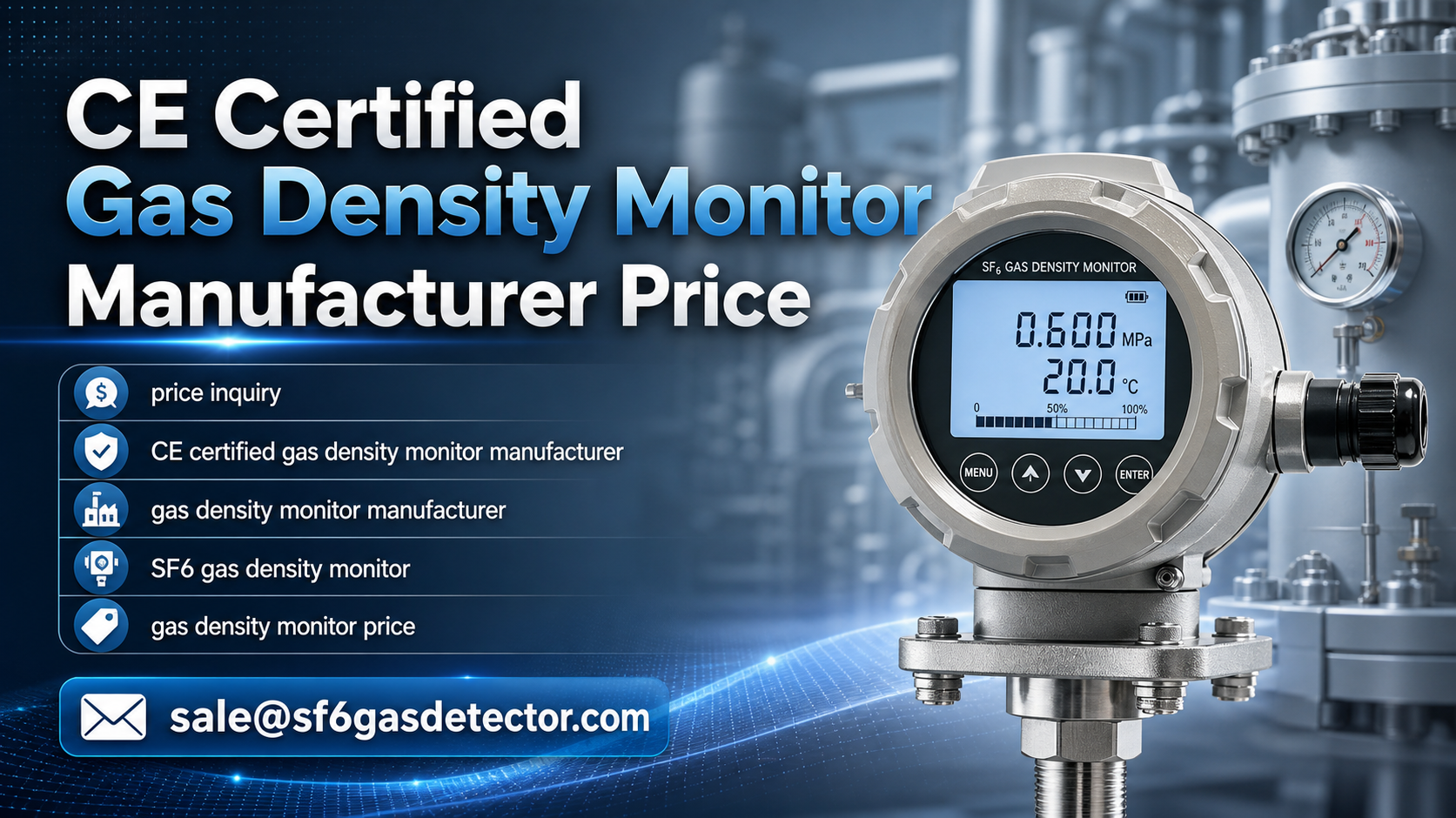
CE Certified Gas Density Monitor Manufacturer Price
Date
2026-07-10
[email protected]
Website
www.sf6gasdetector.com
Get Solutions And Quotes
CE Certified Gas Density Monitor Manufacturer Price
When sourcing a reliable CE certified gas density monitor manufacturer, buyers in power transmission, switchgear manufacturing, and industrial gas management need more than a simple quotation. A professional price inquiry CE certified gas density monitor manufacturer should provide verified compliance documentation, stable product performance, engineering support, and transparent guidance on selection and lifecycle costs. This article explains the advantages, technical parameters, application scenarios, purchasing considerations, and common questions related to SF6 gas density monitor products, helping procurement teams make a confident and standards-compliant decision.
Why CE Certification Matters for Gas Density Monitors
A gas density monitor is a critical safety and monitoring device used to measure gas density and pressure compensation in sealed gas-insulated equipment. In medium- and high-voltage applications, especially where sulfur hexafluoride is used as an insulating and arc-quenching medium, an accurate SF6 gas density monitor helps operators detect gas leakage, maintain safe insulation levels, and reduce the risk of equipment failure.
CE certification indicates that the product meets relevant European Union requirements for safety, electromagnetic compatibility, and applicable industrial standards. For international buyers, choosing a gas density monitor manufacturer with CE-certified products helps simplify import compliance, engineering approval, and project documentation. It also demonstrates that the manufacturer follows controlled production processes, traceable testing, and quality assurance procedures.
Core Advantages of a CE Certified Gas Density Monitor
Accurate Density Compensation
Unlike ordinary pressure gauges, a gas density monitor compensates for temperature changes to reflect the actual gas density condition. This is essential because SF6 gas pressure fluctuates with ambient temperature. A high-quality monitor provides stable indication and reliable alarm or lockout signals according to preset density thresholds.
Enhanced Equipment Safety
In gas-insulated switchgear, circuit breakers, ring main units, and GIS substations, insufficient gas density can reduce insulation performance. A dependable SF6 gas density monitor supports early warning and preventive maintenance, helping operators avoid unplanned outages and safety incidents.
Long Service Life in Harsh Environments
Industrial and power utility environments often involve humidity, vibration, temperature variation, and outdoor exposure. Professional manufacturers typically provide stainless steel housings, anti-corrosion components, high ingress protection ratings, and vibration-resistant designs to ensure stable operation over many years.
Flexible Customization for OEM and Project Needs
A qualified SF6 gas density monitor manufacturer can supply different pressure ranges, alarm contact settings, connection threads, dial sizes, electrical interfaces, and mounting methods. This flexibility is important for switchgear OEMs, EPC contractors, and maintenance companies requiring compatibility with existing equipment.
Typical Technical Parameters of SF6 Gas Density Monitor
The following table summarizes common product specifications. Exact values may vary depending on the model, application, and customer requirements.
| Parameter | Typical Specification | Application Notes |
|---|---|---|
| Measured Medium | SF6 gas or compatible insulating gas | Used in gas-insulated electrical equipment |
| Nominal Pressure Range | 0–0.6 MPa, 0–1.0 MPa, or customized | Selected according to equipment design pressure |
| Accuracy Class | Commonly 1.0, 1.6, or project-specific | Higher accuracy supports stricter monitoring requirements |
| Temperature Compensation | Mechanical or integrated compensation | Ensures density indication independent of temperature variation |
| Alarm Contacts | 1–3 groups available | Supports alarm, interlock, and control functions |
| Operating Temperature | Typically -40°C to +60°C | Suitable for outdoor substations and industrial environments |
| Protection Rating | IP54, IP65, or higher options | Chosen based on installation environment |
| Connection Type | M20×1.5, G1/2, NPT, or customized | Must match equipment gas port specification |
| Certification | CE and applicable test reports | Supports international procurement and project acceptance |
Key Application Scenarios
Gas-Insulated Switchgear and Substations
GIS substations rely on SF6 or alternative insulating gases to maintain electrical insulation. A CE-certified gas density monitor provides continuous supervision of gas conditions and helps operators respond quickly to abnormal density changes.
High-Voltage Circuit Breakers
For SF6 circuit breakers, gas density is directly related to arc-quenching performance. Using a reliable SF6 gas density monitor supports safe switching operation and reduces maintenance uncertainty.
Ring Main Units and Compact Switchgear
Compact equipment requires durable, space-efficient monitoring devices. Manufacturers can provide smaller dial sizes, customized mounting structures, and preset contact values to match RMU requirements.
Industrial Gas Monitoring Systems
Beyond electrical applications, gas density monitoring may be used in sealed industrial gas systems where accurate density supervision is required. Selection should always follow the medium compatibility, pressure rating, and safety requirements of the system.
How to Evaluate Gas Density Monitor Price
When buyers search for gas density monitor price, it is important to compare the total value rather than only the unit cost. A lower purchase price may result in higher risks if the product lacks certification, stable repeatability, or reliable after-sales support.
| Price Factor | Impact on Cost | Buyer Recommendation |
|---|---|---|
| Certification Requirements | CE certification and test reports may increase compliance cost | Request valid documents before purchase |
| Accuracy and Contact Configuration | More precise instruments and multiple contacts may cost more | Choose according to protection logic and project specifications |
| Material and Protection Grade | Stainless steel, IP65, and anti-corrosion options affect price | Match material to indoor, outdoor, or coastal conditions |
| Customization Level | Special threads, dial scales, logos, or alarm points may add cost | Provide drawings and technical requirements early |
| Order Quantity | Bulk orders usually improve unit pricing | Ask for tiered pricing for OEM or project procurement |
| Technical Support | Engineering consultation adds practical value | Prefer suppliers offering selection and installation guidance |
For a formal quotation based on drawings, pressure range, contact settings, and annual demand, buyers can request a professional gas density monitor price inquiry from an engineering sales team.
Purchasing Guide: How to Choose the Right Manufacturer
Verify CE Certification and Quality System
A trustworthy price inquiry CE certified gas density monitor manufacturer should provide CE documentation, inspection records, and product test reports upon request. Buyers should also check whether the manufacturer follows recognized quality management procedures for material control, assembly, calibration, and final testing.
Confirm Technical Compatibility
Before purchasing, confirm the gas type, rated pressure, alarm pressure points, thread connection, installation position, electrical contact rating, ambient temperature, and protection level. These details directly affect product performance and installation safety.
Review Production and Customization Capability
For OEM projects or large utility tenders, the manufacturer should be able to provide consistent batch quality, customized dials, branded labeling, technical drawings, and stable delivery schedules. Strong engineering capability reduces communication errors and project delays.
Evaluate After-Sales Support
Technical support is especially important for international buyers. A reliable supplier should offer installation instructions, wiring guidance, troubleshooting assistance, and replacement recommendations. For customized on-site solutions, procurement managers may contact [email protected] to receive one-on-one guidance from engineers.
Compliance and Operational Standards
Gas density monitors used in power and industrial systems should be selected and installed according to applicable electrical equipment standards, pressure safety principles, and local regulatory requirements. In SF6 applications, operators should also follow environmental management practices for greenhouse gas handling, leak prevention, recovery, and reporting where required. Correct installation, periodic inspection, and proper calibration verification help ensure long-term measurement reliability.
Before putting equipment into service, technicians should verify the sealing condition, electrical contact function, alarm values, and compatibility with the control system. Maintenance work involving SF6 gas should be performed by trained personnel using appropriate recovery and handling equipment.
Frequently Asked Questions
What information is needed for a gas density monitor price inquiry?
To receive an accurate quotation, provide the gas medium, pressure range, alarm and lockout settings, thread size, contact type, dial diameter, protection rating, certification requirements, order quantity, and any drawings or project specifications. Complete information allows the manufacturer to recommend the correct model and quote efficiently.
Is an SF6 gas density monitor the same as a pressure gauge?
No. A pressure gauge only indicates pressure, which changes with temperature. An SF6 gas density monitor compensates for temperature and reflects the actual gas density condition, making it more suitable for safety monitoring in gas-insulated equipment.
How often should gas density monitors be inspected?
Inspection intervals depend on equipment type, operating environment, utility maintenance policy, and local regulations. Many operators include visual inspection, alarm testing, and leakage checks in scheduled maintenance plans. Critical installations may require more frequent verification.
Can gas density monitors be customized?
Yes. A professional gas density monitor manufacturer can customize pressure scales, alarm contact values, connection threads, housing materials, dial markings, electrical interfaces, and mounting arrangements. Customization should be confirmed with technical drawings before production.
What affects the delivery time?
Standard models may have shorter lead times, while customized products require additional time for engineering confirmation, production, calibration, and inspection. Large-volume orders or special certification documentation may also influence delivery schedules.
Conclusion
Selecting a CE-certified gas density monitor is a critical decision for power utilities, switchgear manufacturers, EPC contractors, and industrial maintenance teams. The right manufacturer should offer accurate temperature-compensated monitoring, verified compliance, robust construction, flexible customization, and responsive engineering support. Instead of focusing only on the lowest gas density monitor price, buyers should evaluate certification, reliability, lifecycle value, and technical service.
For project-based selection, OEM customization, or a detailed quotation, contact [email protected] to obtain a tailored solution from a CE certified gas density monitor manufacturer.