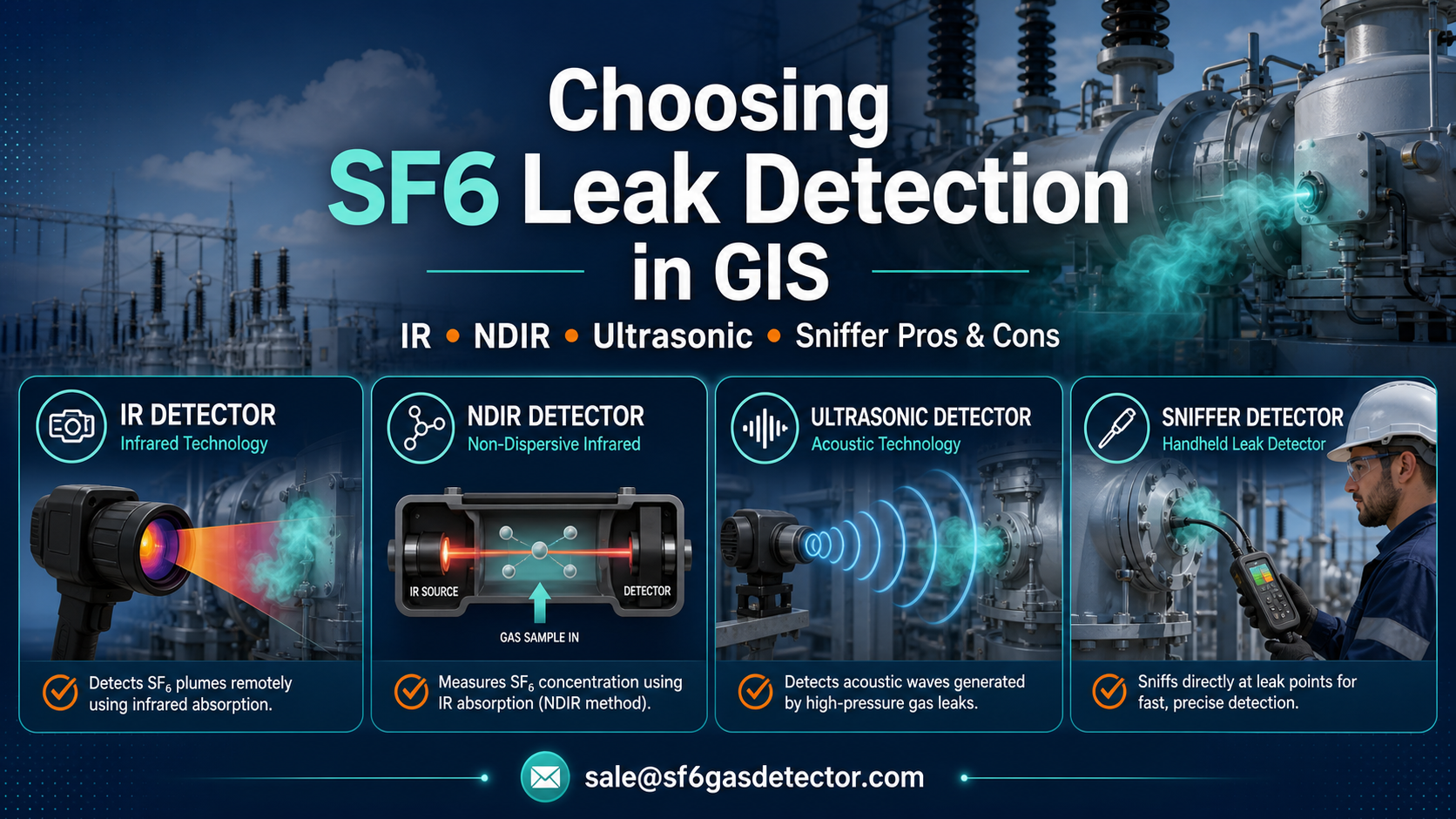
Choosing SF6 Leak Detection in GIS: IR, NDIR, Ultrasonic & Sniffer Pros/Cons
Date
2026-07-20
[email protected]
Website
www.sf6gasdetector.com
Get Solutions And Quotes
Choosing SF6 Leak Detection in GIS: IR, NDIR, Ultrasonic & Sniffer Pros/Cons
What Are the Pros and Cons of Infrared (IR), NDIR, Ultrasonic, and Handheld Sniffer Detectors for SF6 Leak Detection in GIS Substations?
Sulfur hexafluoride (SF6) is widely used as an insulating and arc-quenching gas in gas-insulated switchgear (GIS) substations because of its excellent dielectric strength and chemical stability. However, SF6 is also a regulated greenhouse gas with a very high global warming potential, making accurate leak detection essential for environmental compliance, equipment reliability, and worker safety. For utility operators, EPC contractors, and industrial maintenance teams, understanding what are the pros and cons of infrared (IR), NDIR, ultrasonic, and handheld sniffer detectors for SF6 leak detection in GIS substations is critical when selecting the right inspection technology.
Different SF6 leak detection methods are designed for different operational needs. Some are ideal for fast screening, some provide high sensitivity, and others are better suited for continuous monitoring or pinpoint leak localization. This article compares the core advantages, limitations, technical parameters, application scenarios, and purchasing considerations for the most common SF6 gas leak detector technologies used in GIS substations.
Why SF6 Leak Detection Matters in GIS Substations
GIS substations operate under high-voltage and high-reliability requirements. Even a small SF6 leak can reduce gas pressure, weaken insulation performance, increase the risk of partial discharge, and cause unplanned outages. At the same time, international standards and regulations increasingly require utilities to monitor, report, and reduce SF6 emissions.
Common compliance and operational references include IEC standards for high-voltage switchgear, occupational safety practices for gas handling, and regional greenhouse gas reporting regulations. A professional SF6 leak detection program helps operators:
- Maintain insulation reliability in GIS bays and circuit breakers
- Reduce SF6 gas refill costs
- Improve compliance with environmental reporting requirements
- Support predictive maintenance and asset management
- Protect personnel during inspection and maintenance activities
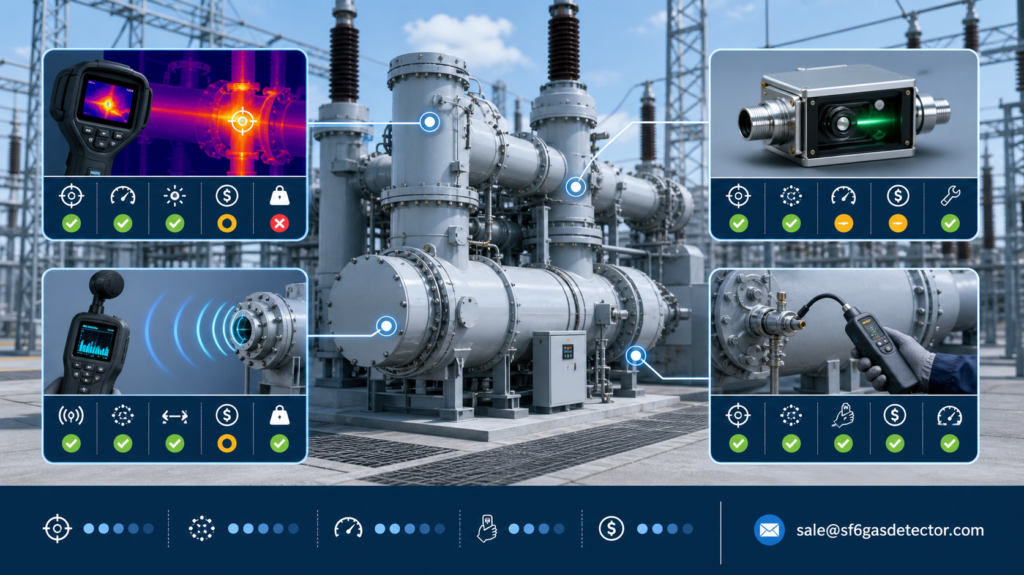
Comparison Table: IR, NDIR, Ultrasonic, and Handheld Sniffer SF6 Leak Detectors
| Detection Technology | Typical Use | Sensitivity | Main Advantage | Main Limitation |
|---|---|---|---|---|
| Infrared Imaging (IR) | Remote visual leak detection | Medium to high | Non-contact, fast area scanning | Higher cost, affected by imaging conditions |
| NDIR Sensor | Fixed or portable quantitative detection | High | Stable gas-specific measurement | Requires air sampling and calibration |
| Ultrasonic Detector | Pressurized gas leak screening | Medium | Detects leak sound without gas contact | Cannot identify gas type |
| Handheld Sniffer | Pinpoint leak localization | Very high at close range | Accurate leak source confirmation | Requires close access to equipment |
Infrared (IR) SF6 Leak Detectors
Infrared SF6 leak detectors use optical imaging technology to visualize gas plumes that are invisible to the human eye. These systems detect the infrared absorption characteristics of SF6 and display leaks as moving clouds or contrast changes on a screen.
Pros of IR SF6 Leak Detection
The biggest advantage of IR technology is non-contact inspection. Technicians can scan GIS equipment, flanges, valve connections, bushings, and gas compartments from a safe distance. This is especially useful in energized substations where direct contact with equipment is restricted.
IR detectors are also efficient for large-area screening. A trained technician can inspect multiple GIS bays quickly without applying soap solution or physically touching components. For high-voltage substations, this improves inspection safety and reduces downtime.
Cons of IR SF6 Leak Detection
IR systems are usually more expensive than conventional portable detectors. Their performance can be influenced by background temperature, wind, distance, camera sensitivity, and operator experience. Very small leaks may be harder to detect if airflow disperses the gas plume quickly.
IR technology is best used as a screening and visualization tool rather than the only method for quantitative leak measurement. In many GIS maintenance programs, IR imaging is combined with a handheld SF6 sniffer detector for final leak source confirmation.
NDIR SF6 Gas Detectors
NDIR, or non-dispersive infrared, detectors measure SF6 concentration by analyzing how the gas absorbs infrared light at specific wavelengths. NDIR technology is widely used in portable SF6 gas detectors, fixed gas monitoring systems, and online environmental monitoring devices.
Pros of NDIR SF6 Detectors
NDIR detectors provide gas-specific measurement and stable long-term performance. Because SF6 has a distinct infrared absorption profile, NDIR sensors can deliver reliable concentration readings in ppm or other calibrated units.
For GIS substations, NDIR SF6 leak detectors are useful for room monitoring, cable trench inspection, gas handling zones, and confined areas where SF6 may accumulate. They are also suitable for continuous monitoring systems in indoor GIS buildings.
Cons of NDIR SF6 Detectors
NDIR detectors usually require air sampling, meaning the gas must enter the sensor chamber before detection occurs. This makes them less suitable for visualizing remote leaks compared with IR cameras. They also require regular calibration, proper pump maintenance, filter inspection, and protection from dust or moisture contamination.
For best results, NDIR detectors should be selected based on response time, detection range, minimum detectable concentration, and alarm configuration. For customized NDIR SF6 monitoring solutions for GIS substations, users can request engineering support via [email protected].
Ultrasonic SF6 Leak Detectors
Ultrasonic leak detectors do not directly detect SF6 gas molecules. Instead, they identify high-frequency sound generated when pressurized gas escapes through a small opening. This makes ultrasonic detectors useful for identifying leaks in pressurized systems regardless of gas type.
Pros of Ultrasonic Leak Detection
Ultrasonic detectors are fast and versatile. They can detect leaks from a distance and are not affected by gas concentration, background chemical interference, or the optical visibility of gas plumes. For pressurized GIS equipment, ultrasonic tools can help maintenance teams quickly locate suspicious leak points.
They are especially valuable in noisy industrial environments when equipped with headphones and frequency filtering. Since they detect sound rather than gas chemistry, they can also be used for compressed air, nitrogen, and other pressurized gas systems.
Cons of Ultrasonic Leak Detection
The main limitation is that ultrasonic detectors cannot confirm whether the leaking gas is SF6. They only indicate that a pressurized gas leak may exist. Performance can also be affected by mechanical noise, corona discharge noise, wind, and equipment vibration.
Ultrasonic detection is best used as a preliminary screening method. Once a suspected leak is found, an SF6-specific handheld sniffer or NDIR detector should be used to verify gas identity and concentration.
Handheld Sniffer SF6 Leak Detectors
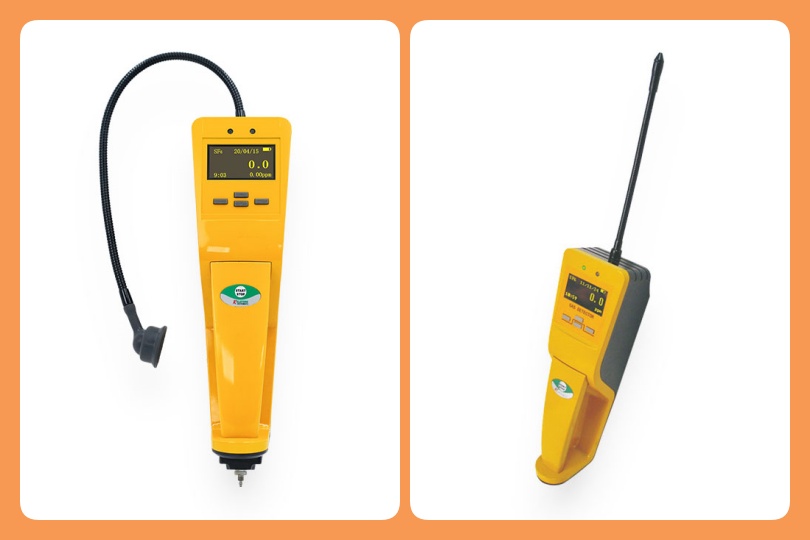
Handheld sniffer detectors are among the most commonly used tools for SF6 leak detection in GIS substations. They use a probe to sample air close to seals, valves, pipe joints, density relay connections, and flange interfaces.
Pros of Handheld Sniffer Detectors
The main advantage of handheld sniffers is pinpoint accuracy. When used close to the leak source, they can detect very small SF6 leaks and help technicians identify exactly where repair is needed. Many modern handheld SF6 leak detectors feature audible alarms, visual displays, flexible probes, fast response times, and adjustable sensitivity levels.
They are also relatively portable and cost-effective, making them practical for routine maintenance, commissioning checks, annual inspections, and post-repair verification.
Cons of Handheld Sniffer Detectors
Handheld sniffers require close access to the suspected leak point. This can be difficult in energized areas, elevated GIS installations, or locations with restricted access. Wind and ventilation can dilute the gas before it reaches the probe, so inspection technique is important.
Operators must move the probe slowly and systematically around sealing surfaces. Improper use may lead to missed leaks or false assumptions about leak severity.
Key Application Scenarios in GIS Substations
Routine GIS Maintenance Inspection
For scheduled maintenance, handheld SF6 sniffer detectors and NDIR portable units are commonly used to inspect flanges, gas density relays, valves, and pipe connections. IR cameras can improve efficiency when inspecting multiple bays.
Indoor GIS Room Monitoring
NDIR fixed SF6 gas monitoring systems are suitable for indoor GIS halls, basements, cable trenches, and enclosed equipment rooms. These systems can provide continuous alarms to support occupational safety and environmental control.
Emergency Leak Investigation
When gas pressure drops unexpectedly, IR imaging can quickly scan large areas, ultrasonic detection can identify pressurized leak noise, and handheld sniffers can confirm the exact leakage point.
Commissioning and Post-Repair Verification
After installation, gasket replacement, valve repair, or gas refilling, handheld sniffer detectors are preferred for final acceptance testing and quality confirmation.
For project-based selection or site-specific detector configuration, engineering teams can obtain one-on-one technical guidance by contacting [email protected].
Technical Parameter Table for Purchasing Evaluation
| Parameter | Recommended Consideration for GIS Substations |
|---|---|
| Detection Gas | SF6-specific detection preferred for confirmation |
| Detection Limit | Low ppm-level sensitivity for small leak detection |
| Response Time | Fast response improves inspection efficiency |
| Alarm Method | Audible, visual, and vibration alarms are useful on site |
| Portability | Lightweight handheld design for routine patrols |
| Sampling Method | Pump suction recommended for sniffer and NDIR units |
| Calibration | Traceable calibration and easy maintenance required |
| Operating Environment | Temperature, humidity, dust, and electromagnetic conditions |
| Data Logging | Useful for compliance records and maintenance history |
| Safety Compliance | Must meet applicable industrial electrical and safety standards |
Purchasing Guide: How to Choose the Right SF6 Leak Detector
Define the Inspection Purpose
If the goal is fast remote screening, IR imaging is a strong choice. If quantitative concentration monitoring is required, NDIR technology is more appropriate. If the task is pinpoint confirmation, a handheld sniffer is usually the most practical option. For pressurized leak screening, ultrasonic detectors can be useful but should not replace SF6-specific verification.
Consider GIS Site Conditions
Indoor GIS buildings, outdoor substations, high-voltage energized zones, ventilation conditions, and equipment accessibility all influence detector selection. For complex substations, combining two or more technologies often delivers the best results.
Evaluate Maintenance and Calibration Requirements
Professional SF6 leak detection equipment should include calibration support, replaceable filters, durable probes, clear alarms, and documentation suitable for industrial quality management systems.
Balance Cost and Risk
Lower-cost detectors may be sufficient for occasional inspections, while utilities with large GIS fleets may benefit from higher-performance IR or fixed NDIR systems. The right investment should reduce gas loss, prevent outages, and support environmental compliance.
For a customized on-site SF6 leak detection plan based on GIS layout, inspection frequency, and compliance requirements, contact [email protected] for a free consultation.
Frequently Asked Questions
Which SF6 leak detector is most accurate?
For pinpoint leak localization, handheld SF6 sniffer detectors are often the most accurate when used close to the leak source. For concentration measurement, NDIR detectors provide stable and gas-specific readings.
Can ultrasonic detectors detect SF6 directly?
No. Ultrasonic detectors detect the sound of pressurized gas escaping. They cannot identify the gas type, so SF6-specific confirmation is still required.
Are IR cameras suitable for all SF6 leaks?
IR cameras are excellent for visualizing many SF6 leaks from a distance, but very small leaks, strong wind, poor background contrast, or long inspection distances can reduce effectiveness.
What is the best solution for indoor GIS substations?
A combination of fixed NDIR SF6 monitoring for continuous safety, handheld sniffers for routine inspection, and IR imaging for periodic screening is often the most effective approach.
How often should SF6 leak detectors be calibrated?
Calibration frequency depends on manufacturer recommendations, site procedures, and regulatory requirements. Many industrial users perform calibration annually or before critical inspection campaigns.
Final Selection Recommendation
There is no single detector that is best for every SF6 leak detection task. IR detectors provide safe remote visualization, NDIR detectors deliver reliable concentration measurement, ultrasonic detectors help identify pressurized leak signals, and handheld sniffer detectors offer precise leak source confirmation. For GIS substations, the most professional approach is to match the detection technology to the application scenario and, when necessary, combine multiple methods for higher reliability, better compliance, and reduced SF6 emissions.