Get a Fast Quote: SF6 Dew Point Meter for C4 Mixed-Gas GIS
Date
2026-09-02
[email protected]
Website
www.sf6gasdetector.com
Get Solutions And Quotes
Contact Factory
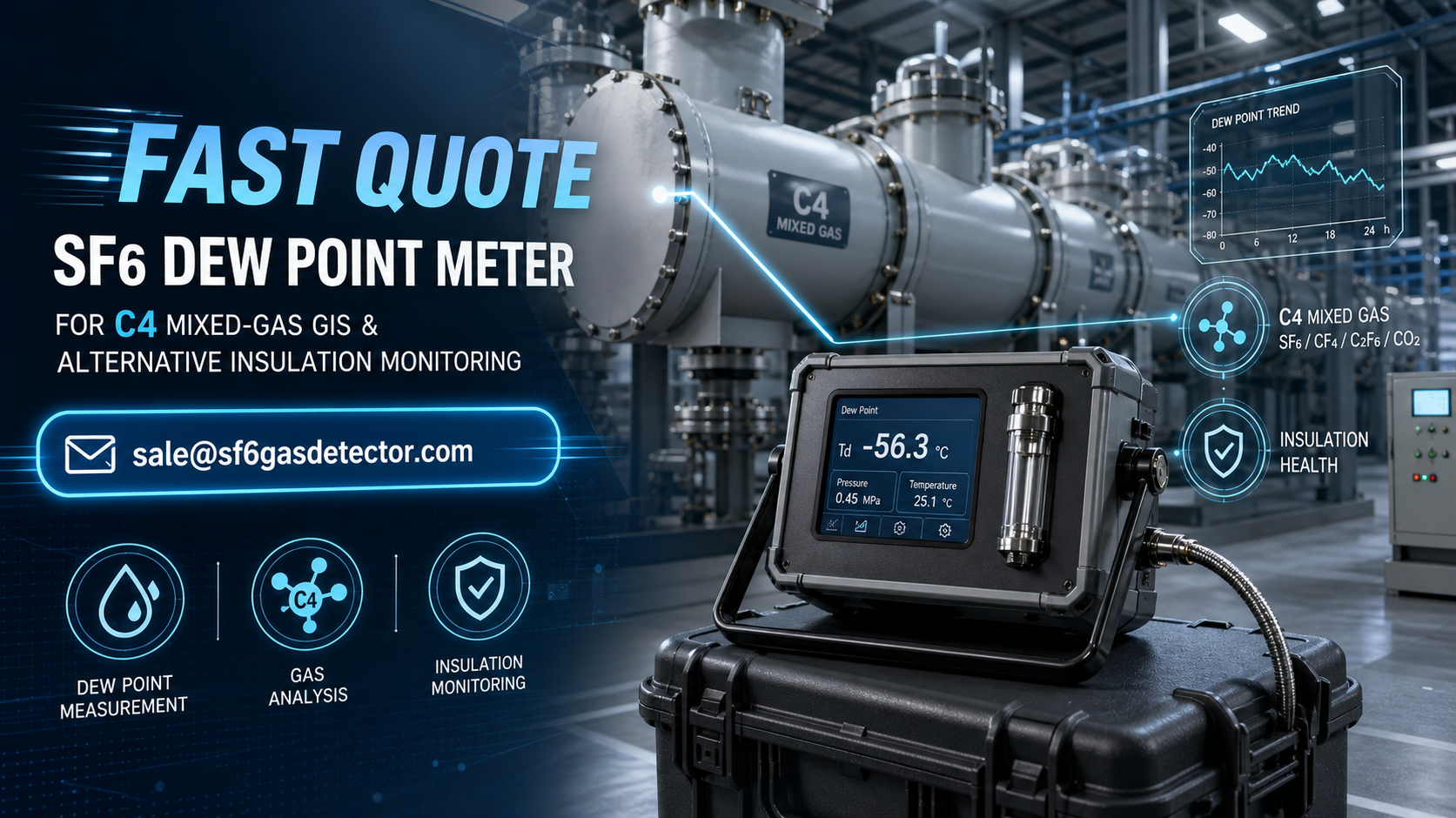
Get a Fast Quote: SF6 Dew Point Meter for C4 Mixed-Gas GIS
When utilities transition from conventional SF6 insulation to C4-based mixed-gas systems, moisture measurement becomes a critical part of gas-quality control, commissioning, and lifecycle maintenance. A request to quote SF6 dew point meter for C4 mixed-gas GIS alternative insulation monitoring should therefore focus on more than the instrument price. The selected analyzer must provide reliable low-moisture performance, suitable gas-path materials, traceable calibration, and safe recovery procedures for the specific alternative insulation mixture used in the GIS.
C4 mixed-gas technology—commonly based on fluoronitrile compounds blended with CO2, O2, or other carrier gases—has different physical properties from pure SF6. However, the operational goal remains the same: control water vapor to protect dielectric strength, prevent condensation, and support long-term gas-insulated switchgear reliability.
Why Dew Point Measurement Matters in C4 Mixed-Gas GIS
A professional quote SF6 dew point meter for C4 mixed-gas GIS alternative insulation monitoring should identify the required moisture range, pressure conditions, sampling configuration, and reporting units before specifying a model. Dew point is commonly reported in °C, °F, ppmv, ppmw, or frost point. For GIS maintenance teams, ppmv and pressure-corrected dew point values are particularly useful when comparing results with equipment manufacturer limits.
Excess moisture in an alternative-insulation GIS can contribute to several operational risks:
- Reduced dielectric margin under elevated electric field conditions
- Condensation risk during temperature changes or pressure reduction
- Increased possibility of corrosion in metallic gas compartments
- Inconsistent gas-quality acceptance results during commissioning
- Difficulty confirming compliance with manufacturer-defined moisture limits
The correct moisture threshold is not universal. It must be based on the GIS manufacturer’s technical documentation, gas-mixture composition, operating pressure, temperature range, and applicable utility maintenance procedures.
Key Technical Parameters to Specify
Measurement Range and Accuracy
When requesting a quote SF6 dew point meter for C4 mixed-gas GIS alternative insulation monitoring, define the expected water-vapor range rather than selecting equipment only by its lowest advertised detection limit. GIS applications often require accurate measurement at very low moisture levels, where sensor stability and sample-handling discipline are essential.
Important parameters include:
- Dew point or frost point measurement range
- Accuracy and repeatability at the intended operating range
- Resolution in °C or ppmv
- Response time and recovery time after exposure to higher moisture
- Operating pressure range and pressure-compensation method
- Warm-up requirements and field portability
A chilled-mirror hygrometer can provide high-reference accuracy in controlled applications, while polymer or ceramic moisture sensors may offer practical portability for routine field checks. The appropriate choice depends on required uncertainty, testing frequency, and maintenance environment.
Compatibility With Alternative Gas Mixtures
A standard SF6 moisture analyzer is not automatically suitable for every C4 mixed-gas application. For a dependable quote SF6 dew point meter for C4 mixed-gas GIS alternative insulation monitoring, verify that the manufacturer confirms compatibility with the actual fluoronitrile-based mixture and concentration.
The gas path should use materials suitable for dry, clean insulating-gas service, such as properly selected stainless steel components, valves, seals, and tubing. Sampling systems should minimize adsorption, leakage, dead volume, and ambient-air ingress. Where the mixture contains oxygen or other components, material compatibility and safety requirements should be reviewed according to the gas supplier’s safety data sheet.
Gas Recovery and Low-Emission Sampling
Gas loss is a practical and environmental concern. A complete quote SF6 dew point meter for C4 mixed-gas GIS alternative insulation monitoring should state whether the device supports closed-loop sampling, internal gas recovery, or connection to an external recovery system.
Low-volume sampling reduces the amount of gas removed from the compartment and helps avoid unnecessary handling of fluorinated insulating gases. For critical installations, specify sample volume per test, recovery efficiency, connection type, hose length, and whether a vacuum or purge sequence is required between measurements.
Standards, Calibration, and Documentation
For procurement quality assurance, a quote SF6 dew point meter for C4 mixed-gas GIS alternative insulation monitoring should include calibration and documentation requirements. While IEC 60376 and IEC 60480 are widely referenced for SF6 gas quality and reuse practices, alternative gas mixtures must be evaluated against the GIS manufacturer’s instructions and project-specific specifications rather than assumed to follow SF6 limits directly.
Relevant technical references may include:
- IEC 62271-1 for common specifications for high-voltage switchgear and controlgear
- IEC 62271-203 for gas-insulated metal-enclosed switchgear
- IEC 60376 for technical-grade SF6 used in electrical equipment
- IEC 60480 for SF6 reuse and handling guidance
- ISO/IEC 17025 calibration traceability requirements for accredited laboratories
Request a calibration certificate with traceability to recognized national or international standards. For utility acceptance testing, it is also advisable to define calibration interval, sensor verification procedure, service support, and recommended annual maintenance.
For project-specific selection support, obtain one-on-one guidance from engineers who can review gas composition, pressure, and required reporting format before the instrument is ordered.
Scenario-Based Selection for GIS Operators
New GIS Commissioning
During factory acceptance, site acceptance, or post-installation commissioning, a quote SF6 dew point meter for C4 mixed-gas GIS alternative insulation monitoring should prioritize repeatability, traceable calibration, and controlled sampling. The instrument should support clear test records for each gas compartment, including compartment ID, pressure, temperature, date, operator, and moisture result.
Routine Preventive Maintenance
For periodic maintenance teams, portability and rapid stabilization are often decisive. A field-ready quote SF6 dew point meter for C4 mixed-gas GIS alternative insulation monitoring should include robust transport protection, battery capability where needed, quick-connect fittings, and a simple data-logging workflow.
Investigation After Gas Handling or Alarm Events
After gas filling, leak repair, abnormal pressure changes, or moisture-related alarms, a quote SF6 dew point meter for C4 mixed-gas GIS alternative insulation monitoring should support repeat measurements without excessive gas consumption. Testing should follow approved gas-handling procedures and confirm that measured values are stable before conclusions are made.
How to Request an Accurate Quotation
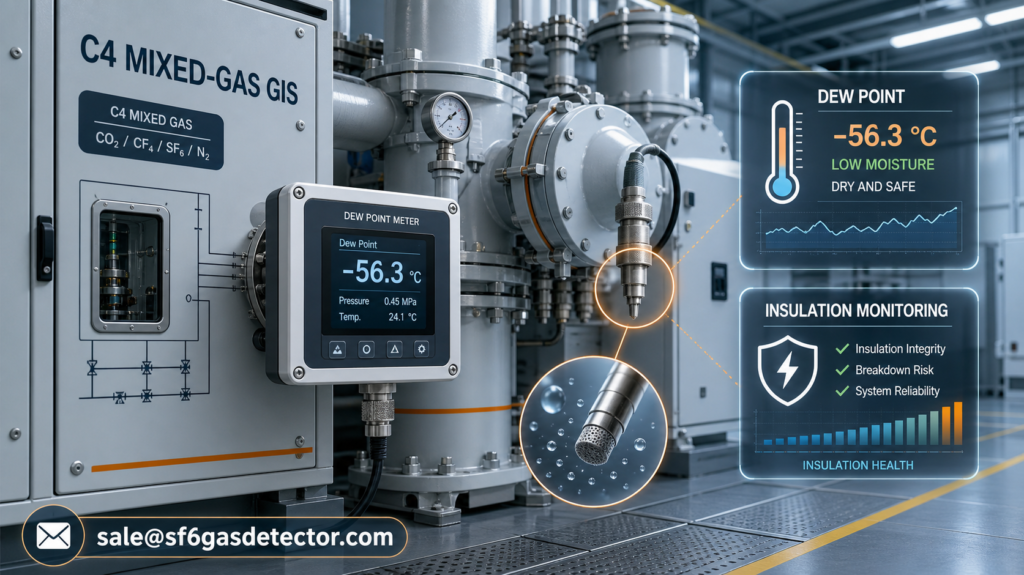
To receive an accurate quote SF6 dew point meter for C4 mixed-gas GIS alternative insulation monitoring, provide the gas mixture name, nominal pressure, expected dew point range, required accuracy, connection standard, recovery preference, and required certification documents. Also confirm whether the instrument will be used for commissioning, maintenance, laboratory verification, or emergency diagnostics.
Buyers can quickly obtain product quotations by supplying these technical details together with the destination country and expected delivery schedule.
Frequently Asked Questions
Can an SF6 dew point meter measure C4 mixed gases?
A quote SF6 dew point meter for C4 mixed-gas GIS alternative insulation monitoring should only be accepted after the supplier confirms sensor and gas-path compatibility with the specific C4-based mixture. The meter may measure water vapor effectively, but performance must be validated for the actual gas composition and pressure.
Should dew point be measured under pressure?
Yes. Pressure affects the relationship between dew point and water-vapor concentration. Results should be reported with the measurement pressure or converted using the instrument’s documented compensation method.
What certificate should be included with the meter?
At minimum, request a traceable calibration certificate. For regulated utility or laboratory applications, an ISO/IEC 17025-accredited calibration certificate may be required by the purchaser’s quality system.
How often should a dew point meter be calibrated?
Calibration frequency depends on use intensity, moisture exposure, manufacturer recommendations, and internal quality procedures. Annual calibration is common, but critical applications may require more frequent verification.