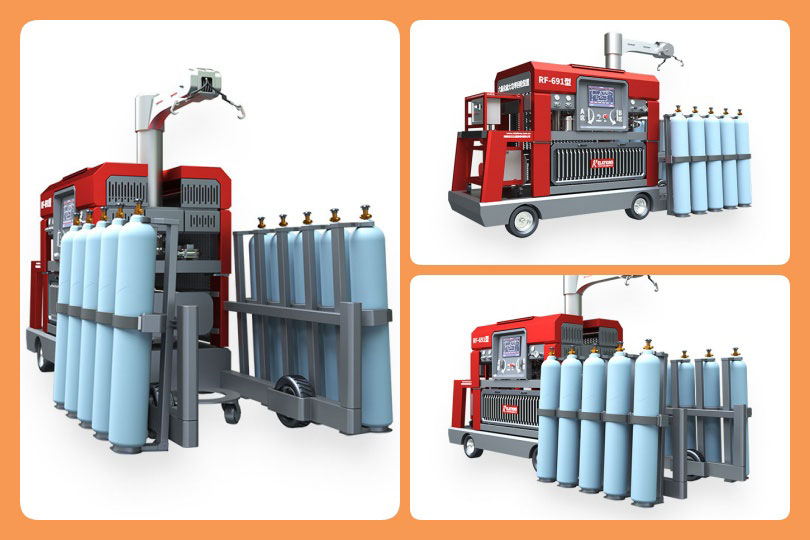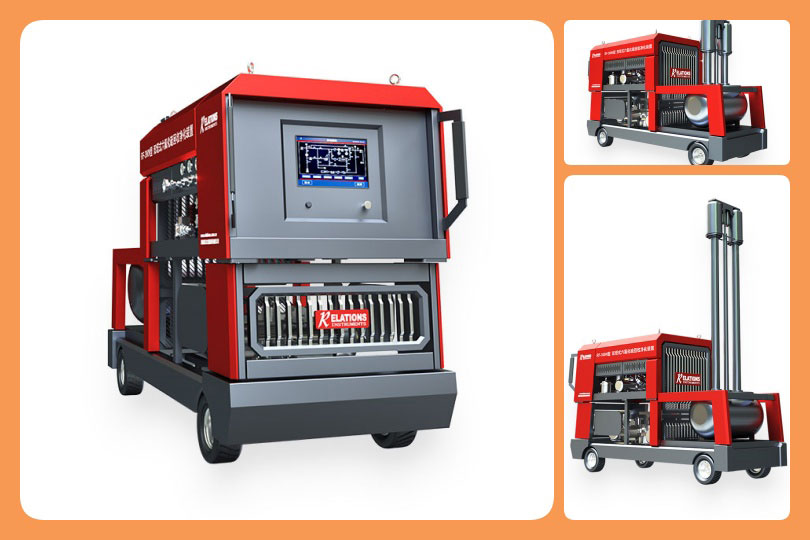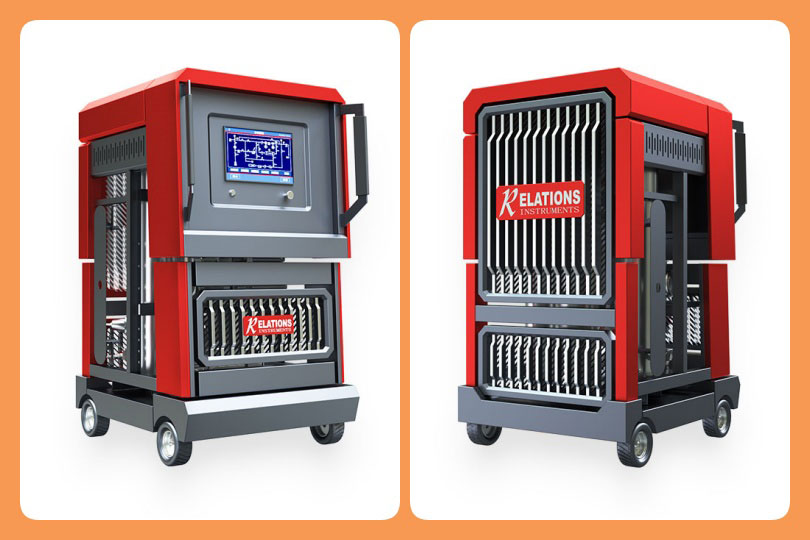
Request a Quote for SF6 Regeneration Services for GIS Switchgear

Date
2026-08-24
[email protected]
Website
www.sf6gasdetector.com
Get Solutions And Quotes
Contact Factory
Request a Quote for SF6 Regeneration Services for GIS Switchgear
When operators need to request a quote SF6 regeneration service manufacturer for GIS switchgear, the priority is not simply obtaining a price. A technically sound quotation should define the gas quality target, recovery scope, regeneration process, compliance requirements, turnaround time, and verification documentation. For gas-insulated switchgear (GIS), SF6 condition directly affects dielectric strength, arc-quenching performance, equipment reliability, and environmental compliance.
An experienced SF6 regeneration service manufacturer helps utilities, substations, industrial plants, rail networks, and renewable-energy facilities restore contaminated or used SF6 to a verified reusable condition. This approach can reduce virgin-gas consumption, minimize outage risk, and support responsible gas lifecycle management.
Why SF6 Regeneration Matters for GIS Switchgear
GIS switchgear is designed around the exceptional insulation and interruption properties of sulfur hexafluoride. However, gas quality can deteriorate during normal operation, internal switching events, maintenance activities, leaks, moisture ingress, or fault interruptions.
Impurities may include moisture, air, particulate matter, acidic by-products, oil vapor, and decomposition compounds such as sulfur fluorides. If not properly treated, contaminated gas may contribute to reduced insulation margins, corrosion concerns, inaccurate gas monitoring, and higher maintenance costs.
A professional request quote SF6 regeneration service manufacturer for GIS switchgear process should therefore assess both the gas and the equipment application. Service providers should not offer a generic recovery package without confirming gas volume, initial purity, moisture concentration, decomposition-product risk, and the required reuse standard.
Common Reasons to Regenerate SF6
- Scheduled GIS maintenance or gas compartment opening
- Recovery of SF6 after breaker overhaul or retrofit work
- Treatment of gas affected by moisture or air contamination
- Recovery after switching faults or internal arc events
- Decommissioning and reuse planning for older GIS assets
- Environmental programs seeking to reduce new SF6 purchases
Key Technical Parameters to Include in an SF6 Regeneration Quote Request
To receive an accurate proposal, provide as much operating information as possible. A capable SF6 regeneration service manufacturer for GIS switchgear will use these details to size the equipment, select the filtration and purification stages, prepare safety controls, and define acceptance testing.
1. GIS Equipment and Gas Inventory
Identify the GIS manufacturer, voltage class, equipment type, compartment arrangement, and estimated SF6 quantity. State whether the gas comes from circuit breakers, bus ducts, current transformers, voltage transformers, or mixed compartments.
Useful information includes:
- Total SF6 mass or cylinder equivalent
- Number of gas compartments
- Nominal gas pressure and operating temperature
- Site location and access limitations
- Required outage window
- Existing gas handling connections and couplings
2. Initial SF6 Quality Data
Where available, include recent test results for SF6 purity, dew point or moisture content, air content, and decomposition by-products. Portable analyzers may provide preliminary field data, while laboratory testing can be appropriate for severely contaminated gas.
For GIS applications, regenerated gas should be evaluated against the relevant gas-quality requirements for the intended reuse. IEC 60480 provides guidance on the reuse of recovered SF6 and specifies considerations for assessing used gas. IEC 62271 series requirements may also apply depending on the switchgear configuration and maintenance activity.
3. Required Regeneration Outcome
Specify whether the objective is reuse within the same GIS installation, reuse in another controlled application, storage for future maintenance, or preparation for authorized disposal. The service scope may include recovery, separation, vacuum evacuation, filtration, drying, purification, cylinder filling, analysis, labeling, and gas inventory reporting.
A precise request quote SF6 regeneration service manufacturer for GIS switchgear inquiry should also ask for the guaranteed or target parameters after treatment, such as SF6 purity, moisture level, air content, and acceptable decomposition-product limits.
Compliance, Safety, and Environmental Documentation
SF6 is a fluorinated greenhouse gas with a very high global warming potential. Proper recovery and regeneration are therefore environmental responsibilities as well as technical maintenance practices. The service provider should operate with documented procedures that prevent uncontrolled releases and maintain traceability from collection through reuse, storage, or final treatment.
Relevant standards and regulatory frameworks may include IEC 60480 for reused SF6, IEC 62271 equipment standards, IEC 60376 for new technical-grade SF6, ISO 14001 environmental management principles, and applicable regional fluorinated-gas regulations. In the European Union, Regulation (EU) 2024/573 establishes updated requirements for fluorinated greenhouse gases. Local environmental, transport, occupational safety, and hazardous-waste rules must also be followed.
What a Professional Service Report Should Contain
A complete service package should provide evidence that the work was controlled and the gas meets the agreed requirement. Typical documentation includes:
- Gas recovery quantity and cylinder identification
- Before-and-after gas analysis results
- Regeneration or filtration process record
- Leak-prevention and vacuum records where applicable
- Final gas storage and labeling information
- Waste or by-product handling documentation
- Technician qualifications and calibration status of testing equipment
For project-specific support, obtain a quick SF6 regeneration quotation with your GIS gas volume, test data, and planned service date.
Scenario-Based SF6 Regeneration Solutions
Routine GIS Maintenance
During planned maintenance, SF6 is recovered from isolated compartments before opening equipment. Regeneration enables the gas to be dried, filtered, analyzed, and returned to service when it meets the agreed specification. This can shorten procurement lead times and reduce dependence on virgin gas.
Moisture or Air Contamination
Moisture can enter a gas compartment through leaks, inadequate evacuation, poor handling practices, or component replacement. Air contamination can lower the effective SF6 concentration and affect insulation performance. In this scenario, the provider should assess the contamination level before confirming whether regeneration is technically and economically appropriate.
Fault-Affected Gas
Gas exposed to electrical arcing may contain toxic, corrosive, or reactive decomposition products. Handling requires controlled recovery, suitable personal protective equipment, sealed filtration systems, and documented waste management. A request quote SF6 regeneration service manufacturer for GIS switchgear should clearly disclose fault history so the provider can prepare the correct safety and purification plan.
How to Select an SF6 Regeneration Service Manufacturer
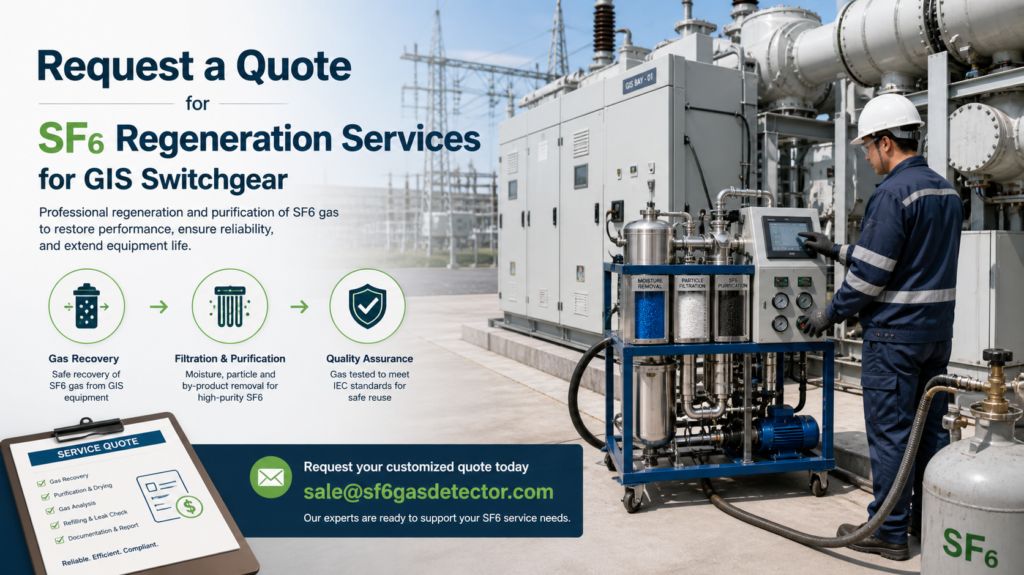
Choose a manufacturer or service partner with proven GIS experience, calibrated gas analyzers, dedicated recovery and purification equipment, trained personnel, and transparent test documentation. Ask whether the company can support on-site service, off-site processing, emergency recovery, cylinder logistics, and post-service gas verification.
Avoid selecting solely on the lowest price. A low-cost offer that excludes testing, safety measures, contamination treatment, or reporting can create technical and regulatory exposure later. The best quotation clearly states inclusions, exclusions, assumptions, gas acceptance criteria, and responsibility for non-regenerable gas.
For complex substations or fault-contaminated compartments, request one-on-one guidance from SF6 engineers before finalizing your maintenance plan.
Frequently Asked Questions
Can recovered SF6 always be reused in GIS switchgear?
No. Reuse depends on the measured gas condition, contamination type, regeneration capability, and applicable technical requirements. Gas should only be returned to GIS service after verification against the agreed quality criteria and relevant standards.
What information is needed to request a quote for SF6 regeneration service?
Provide the GIS model, voltage class, approximate SF6 quantity, current gas test data, contamination history, site location, service schedule, and desired final gas use. This allows the provider to issue a technically accurate quotation.
Is SF6 regeneration safer than venting contaminated gas?
Yes. Controlled recovery and regeneration prevent avoidable atmospheric emissions and enable safe management of contaminated gas and by-products. Venting SF6 is environmentally irresponsible and may violate applicable regulations.
How long does GIS SF6 regeneration take?
Timing depends on gas volume, impurity level, equipment accessibility, test requirements, and whether gas must be processed on site or transported. A professional service provider should define the expected duration and outage requirements in the quotation.
What happens if the gas cannot be regenerated?
If testing shows that regeneration is unsuitable, the provider should identify the appropriate controlled handling, authorized treatment, or disposal route in accordance with local environmental and hazardous-material requirements.