SF6 Gas Detector Supplier for Reliable GIS Switchgear Monitoring

Date
2026-08-13
[email protected]
Website
www.sf6gasdetector.com
Get Solutions And Quotes
Contact Factory
SF6 Gas Detector Supplier for Reliable GIS Switchgear Monitoring
Gas-insulated switchgear (GIS) depends on stable sulfur hexafluoride (SF6) gas conditions to maintain insulation performance, interrupting capability, and long-term operational reliability. Choosing an experienced SF6 gas detector manufacturer supplier for GIS switchgear is therefore more than a procurement decision—it is a key part of preventive maintenance, personnel safety, regulatory compliance, and asset lifecycle management. The right detection solution helps utility operators, substations, OEMs, and industrial facilities identify gas leakage, assess gas quality, and respond before minor abnormalities become costly outages.
Why SF6 Monitoring Matters in GIS Switchgear
SF6 is widely used in high-voltage GIS because of its excellent dielectric strength and arc-quenching properties. However, SF6 is also a potent greenhouse gas, so responsible gas management is essential. Leakage control, recovery, accurate measurement, and documented maintenance are increasingly important for grid operators and equipment owners.
An SF6 gas detector for GIS switchgear supports several critical objectives:
- Early detection of leaks around flanges, valves, seals, density monitors, and gas compartments
- Verification of gas concentration in enclosed or poorly ventilated areas
- Maintenance planning based on measured condition rather than fixed intervals alone
- Improved compliance with environmental and workplace safety requirements
- Reduced gas losses, unplanned downtime, and repair costs
For fixed GIS installations, continuous monitoring can provide alarms when ambient SF6 concentration exceeds configured limits. For maintenance teams, portable SF6 leak detectors and gas analyzers offer flexible inspection capabilities during commissioning, periodic maintenance, and fault investigation.
Key Detector Types for GIS Applications
A qualified SF6 gas detector manufacturer supplier for GIS switchgear should offer solutions suited to both installed monitoring and field-service workflows.
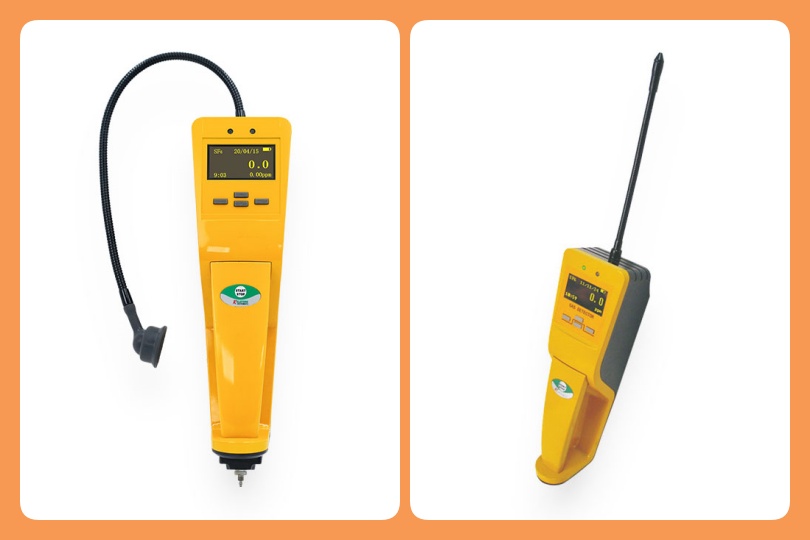
Portable SF6 Leak Detectors
Portable leak detectors are used to locate small SF6 leaks at specific points on GIS equipment. Technicians typically inspect sealing interfaces, bushings, pressure-relief devices, gas filling connections, and compartment joints.
High-quality portable instruments should provide:
- High sensitivity for trace-leak detection
- Fast response and recovery time
- Audible, visual, and vibration alarms
- Adjustable sensitivity settings
- Flexible probes for hard-to-reach GIS areas
- Stable performance in typical substation environments
For maintenance contractors and utility service teams, portable devices are often the most practical option for routine leak surveys and repair verification.
Fixed SF6 Area Monitoring Systems
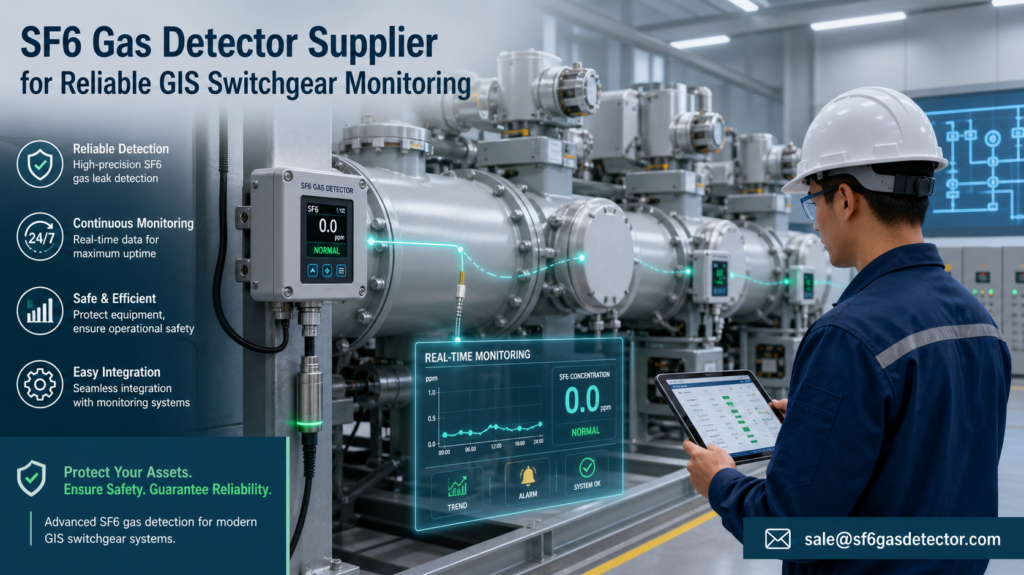
Fixed SF6 gas monitoring systems are installed in GIS halls, underground substations, control rooms, and other enclosed spaces where gas accumulation could create operational or safety concerns. These systems continuously measure ambient SF6 concentration and can connect with local alarms, ventilation systems, SCADA platforms, or building management systems.
A fixed system may include wall-mounted transmitters, controller panels, alarm beacons, relay outputs, and communication interfaces such as Modbus RTU, Modbus TCP, or 4–20 mA outputs. The final configuration should reflect room volume, ventilation conditions, GIS layout, and the site’s risk assessment.
SF6 Gas Quality Analyzers
While leak detectors identify escaped gas, SF6 gas analyzers assess the condition of gas inside GIS compartments. Common measurement parameters include SF6 purity, moisture content or dew point, and decomposition by-products. These values help maintenance teams evaluate whether the gas remains suitable for service or requires treatment, reclamation, or replacement.
Performance Parameters That Influence Procurement
When comparing an SF6 gas detector manufacturer supplier for GIS switchgear, buyers should evaluate measurable specifications rather than relying only on general product descriptions.
Detection Range and Resolution
The required detection range depends on the task. Trace leak detection requires very high sensitivity, while area monitoring requires a reliable concentration range appropriate for the protected environment. Resolution and repeatability are especially important where trending data or compliance records are needed.
Response Time and Alarm Reliability
Fast response supports rapid maintenance decisions and safer work practices. Alarm thresholds should be configurable according to the site’s safety procedures and local regulations. For fixed detectors, confirm whether fault alarms, sensor failure indications, and relay-based emergency outputs are included.
Environmental Durability
GIS switchgear facilities can experience temperature variation, dust, vibration, electromagnetic interference, and humidity. Select instruments with an operating temperature range and enclosure protection rating appropriate for the installation environment. For outdoor auxiliary areas or demanding industrial sites, IP-rated housings may be necessary.
Calibration and Maintenance Requirements
Sensor stability, calibration intervals, and service availability directly affect total cost of ownership. A professional supplier should provide calibration procedures, recommended maintenance schedules, traceable test records, and clear guidance on sensor replacement where applicable.
Standards, Certifications, and Compliance Considerations
Reliable SF6 detection equipment should be designed and manufactured under recognized quality-management practices, such as ISO 9001. Depending on the product configuration and destination market, buyers may also require CE marking, RoHS compliance, EMC conformity, or other applicable certifications.
For GIS-related applications, relevant technical references commonly include IEC 62271 series requirements for high-voltage switchgear and controlgear, along with IEC guidance concerning SF6 handling and gas quality management. Equipment owners should also consider local environmental reporting obligations and workplace safety requirements.
Certification alone is not sufficient. Procurement teams should request technical datasheets, calibration certificates where applicable, inspection records, communication protocols, wiring diagrams, and installation guidance. This documentation supports traceability during commissioning, audits, and future maintenance.
Selecting the Right Supplier for Your GIS Project
A capable SF6 gas detector manufacturer supplier for GIS switchgear should understand the difference between leak detection, ambient safety monitoring, and gas-quality analysis. These functions may be complementary, but they are not interchangeable.
For a new GIS substation, the supplier should be able to recommend detector placement based on gas risk zones, room airflow, equipment access, and alarm integration requirements. For existing switchgear, the focus may be on portable leak survey tools, retrofit-compatible transmitters, or analyzer equipment that minimizes gas loss during testing.
When sourcing equipment, review the following:
- Technical fit for GIS voltage class, site layout, and maintenance workflow
- Calibration, after-sales service, and spare-part availability
- Integration with SCADA, PLC, or local alarm systems
- Documentation quality and certification support
- Lead time, warranty, and lifecycle service capability
For project-specific models, technical configurations, or delivery schedules, you can quickly obtain a product quotation with your GIS application details and required quantity.
Scenario-Based Solutions for Common GIS Needs
GIS Hall Safety Monitoring
In an enclosed GIS hall, fixed SF6 transmitters can be installed near potential accumulation zones, taking into account the gas’s physical behavior, ventilation arrangement, and room geometry. When concentrations exceed preset thresholds, the system can activate alarms and ventilation interlocks to support site emergency procedures.
Routine Preventive Leak Surveys
For utility maintenance teams, a handheld SF6 leak detector allows technicians to inspect critical sealing locations during planned outages. Re-testing after gasket replacement or valve servicing verifies repair quality before equipment returns to service.
SF6 Quality Verification During Commissioning
During commissioning or major maintenance, an SF6 gas analyzer can confirm purity and moisture levels before GIS energization. Proper sampling procedures are essential to avoid contamination, inaccurate readings, or unnecessary gas emissions.
Frequently Asked Questions
What is the difference between an SF6 leak detector and an SF6 gas analyzer?
An SF6 leak detector identifies gas escaping from equipment and helps locate the leak source. An SF6 gas analyzer measures gas condition inside a sealed compartment, such as purity, moisture, and decomposition products. Many GIS maintenance programs require both types of equipment.
How often should GIS switchgear be checked for SF6 leakage?
Inspection frequency should follow the GIS manufacturer’s maintenance instructions, site operating procedures, environmental requirements, and historical leak performance. High-risk or aging equipment may require more frequent surveys.
Can fixed SF6 detectors connect to a SCADA system?
Yes. Many industrial fixed detectors support outputs such as 4–20 mA, RS-485, Modbus RTU, or Modbus TCP. Confirm protocol compatibility and alarm logic during the design stage.
What information should I provide when requesting a detector recommendation?
Provide the GIS model, installation location, room dimensions, number of gas compartments, monitoring purpose, required communication method, environmental conditions, and applicable certification requirements. For tailored selection support, request one-on-one guidance from engineers before finalizing your specification.