SF6 Gas Purity Control for Cleaner, More Reliable Semiconductor Manufacturing
Date
2026-08-28
[email protected]
Website
www.sf6gasdetector.com
Get Solutions And Quotes
Contact Factory
SF6 Gas Purity Control for Cleaner, More Reliable Semiconductor Manufacturing
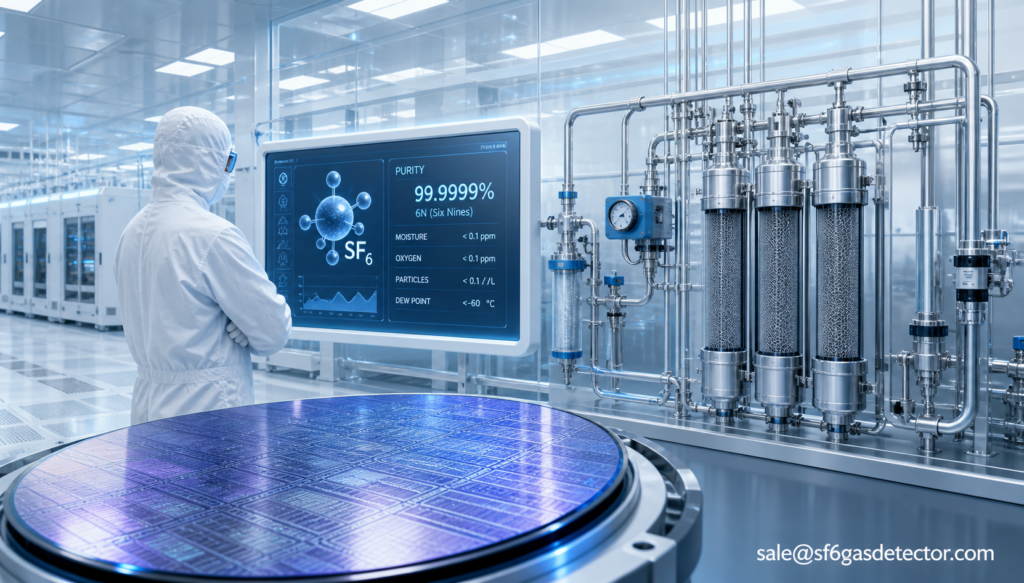
In Semiconductor Manufacturing, process gas quality directly affects device yield, reliability, and production consistency. SF6 gas purity control in clean room environments is especially important where sulfur hexafluoride is used for plasma etching, chamber cleaning, leak testing, or specialized dielectric processes. Even trace contamination can alter plasma chemistry, introduce particles, create unwanted residues, and increase variability across wafer lots. A disciplined purity-control program helps fabs protect critical dimensions, maintain stable process windows, and prevent avoidable chip production losses.
Why SF6 Gas Quality Matters in Semiconductor Manufacturing
SF6 is a chemically stable, nonflammable gas with strong electronegative properties. In Semiconductor Manufacturing, it is commonly selected for fluorine-based plasma processes, particularly etching silicon-containing materials and cleaning deposition chambers. Its process performance depends not only on the specified SF6 concentration but also on the absence of moisture, oxygen, hydrocarbons, acids, particles, and cross-contaminants.
Poor SF6 gas purity control in clean room environments can affect semiconductor processes in several ways:
- Moisture can change plasma dissociation behavior and contribute to oxide-related defects.
- Oxygen contamination can alter etch selectivity, sidewall profiles, and film removal rates.
- Hydrocarbons may generate carbon-containing residues that affect downstream deposition or lithography.
- Particles can create killer defects, bridge narrow features, or reduce die yield.
- Reactive degradation products may corrode gas-system components and contaminate process chambers.
For advanced nodes, these risks become more significant because process margins are narrow. A contaminant level that causes no visible concern in a mature production line may lead to measurable yield loss in high-density logic, memory, MEMS, or power semiconductor manufacturing.
Key Purity Parameters for SF6 Gas Supply
Effective SF6 gas purity control in clean room environments begins with a defined specification that reflects the actual process requirement. Semiconductor-grade SF6 is commonly supplied at high purity, often 99.99% or higher, but the total purity number alone is not enough. The impurity profile matters.
Moisture and Oxygen Limits
Water vapor and oxygen should be tightly controlled because both can influence fluorine plasma behavior. Moisture is typically monitored in parts per million or lower, depending on the process sensitivity and gas-delivery design. Online moisture analyzers, calibrated dew-point instruments, and routine cylinder certification review provide practical safeguards.
Oxygen may enter through inadequate purging, compromised fittings, incorrect cylinder change procedures, or leaks in the gas cabinet. Continuous or periodic analysis supports early detection before impurities reach the point of use.
Hydrocarbon and Acidic Contaminant Control
Trace hydrocarbons can originate from lubricants, seals, contaminated regulators, or unsuitable component materials. Acidic contaminants and decomposition products can affect equipment integrity and present safety concerns. A properly engineered gas path should use compatible high-purity components, orbital-welded stainless-steel tubing where required, and validated purge procedures.
Particle Control
Particle contamination must be controlled across the entire delivery chain, not only inside the cleanroom. Cylinder valve protection, point-of-use filtration, clean installation practices, and controlled maintenance all support lower particle risk. In Semiconductor Manufacturing, filters must be selected carefully so they do not introduce flow restriction, outgassing, or incompatible materials.
Cleanroom Gas Delivery Practices That Protect Wafer Yield
A reliable SF6 gas purity control in clean room environments program combines gas specification, delivery-system design, analytical verification, and operating discipline. The goal is to preserve gas quality from the supplier cylinder to the process tool.
Use High-Purity, Dedicated Gas Distribution Systems
SF6 lines should be segregated from incompatible gases and clearly identified. Dedicated gas cabinets, valve manifold boxes, and point-of-use panels help prevent connection errors and cross-contamination. Components should be compatible with the gas service, pressure rating, and required cleanliness level.
High-purity gas systems generally follow recognized semiconductor facility practices, including clean installation, pressure testing, leak testing, controlled purging, and documented commissioning. For facilities operating under ISO 14644 cleanroom classification requirements, gas-system work should be planned to minimize particle generation and preserve the required cleanroom condition.
Apply Validated Purge and Cylinder Change Procedures
Cylinder replacement is a common source of contamination. Before a new cylinder is placed into service, operators should verify the certificate of analysis, cylinder identity, expiry or retest status, valve condition, and connection compatibility. The connection should then be purged according to the approved site procedure before gas is introduced to the distribution line.
A documented changeout procedure reduces the chance of introducing atmospheric moisture, oxygen, or particles. It also supports traceability—an essential element of quality management systems such as ISO 9001.
Monitor Gas Quality at Critical Points
Supplier certificates provide an important baseline, but point-of-use monitoring confirms what reaches the process chamber. Depending on the risk level, fabs may use moisture analyzers, oxygen analyzers, residual gas analysis, particle monitoring, or periodic laboratory testing.
For high-value process tools, alarm limits should be linked to defined corrective actions. If purity deviates from specification, the system should isolate the affected supply, investigate the source, assess impacted wafer lots, and document disposition decisions through the fab’s quality-control process.
For projects requiring a gas-quality review or delivery-system selection, one-on-one guidance from engineers can help align monitoring capability with real process risk.
Compliance, Safety, and Environmental Considerations
SF6 is a potent greenhouse gas, so Semiconductor Manufacturing facilities should manage it responsibly. Appropriate controls include leak detection, preventive maintenance, controlled cylinder handling, recovery practices where applicable, and emissions reporting in line with local environmental requirements.
Operational procedures should also follow applicable safety standards for compressed gases, including hazard communication, gas-cylinder storage, ventilation, emergency response, and personnel training. Relevant facility frameworks may include ISO 45001 occupational health and safety management, ISO 14001 environmental management, and local fire, pressure-system, and chemical-management regulations.
Importantly, gas purity monitoring supports both quality and environmental performance. Detecting a leak or abnormal impurity trend early can reduce product risk while preventing unnecessary SF6 releases.
Scenario-Based Solutions for Common Production Risks
Scenario 1: Unstable Etch Rate Between Wafer Lots
If an etch tool shows unexplained rate variation, investigate SF6 quality alongside RF power, chamber condition, and wafer incoming quality. Check cylinder certificates, moisture and oxygen readings, recent cylinder changes, purge records, and line leak-test results. A small air ingress event can produce instability that appears to be a tool problem.
Scenario 2: Increased Particle Defects After Maintenance
Following gas-panel or line maintenance, elevated particle counts may indicate inadequate cleaning, unsuitable replacement components, or incomplete purge cycles. Requalify the affected gas path, verify filter condition, and confirm that maintenance practices meet cleanroom handling requirements before returning the tool to production.
Scenario 3: Corrosion or Residue in Gas Handling Components
Unexpected corrosion, deposits, or regulator performance issues may signal contaminated SF6, moisture ingress, or inappropriate material selection. Isolate the supply, inspect the complete gas path, and perform targeted impurity analysis. A structured corrective-action process prevents recurrence and protects connected process tools.
Organizations planning a new monitoring point or replacement analyzer can quickly obtain product quotations based on gas type, expected impurity range, installation location, and required alarm interface.
Frequently Asked Questions
What SF6 purity is required for semiconductor applications?
The required grade depends on the process tool and application. High-purity semiconductor-grade SF6 is typically used, but acceptable limits for moisture, oxygen, hydrocarbons, particles, and other impurities should be defined by the tool owner and process engineering team.
Can a high-purity SF6 cylinder still cause contamination?
Yes. Contamination can occur after delivery through improper cylinder changeout, damaged seals, air ingress, contaminated regulators, unsuitable tubing, inadequate purging, or poor maintenance practices. This is why SF6 gas purity control in clean room environments must cover the full delivery system.
How often should SF6 purity be tested?
Testing frequency should be risk-based. Critical processes may require continuous monitoring of selected contaminants, while lower-risk applications may use periodic verification combined with supplier certificates and routine system integrity checks.
Does SF6 purity affect semiconductor yield?
Yes. Impurities can change plasma behavior, increase particles or residues, affect etch uniformity, and create defects. Maintaining stable SF6 gas quality supports consistent wafer processing and helps protect overall yield.
Conclusion
SF6 gas purity control in clean room environments is a practical quality safeguard for modern Semiconductor Manufacturing. By defining impurity limits, using high-purity distribution systems, validating purge procedures, monitoring critical points, and maintaining documented compliance practices, fabs can reduce process variation and protect chip production. The strongest programs treat SF6 purity not as a purchasing specification alone, but as a controlled process parameter from cylinder receipt through wafer processing.